JPMorgan Chase Credit Card Class Action: What Every Cardholder Must Know in 2025–2026

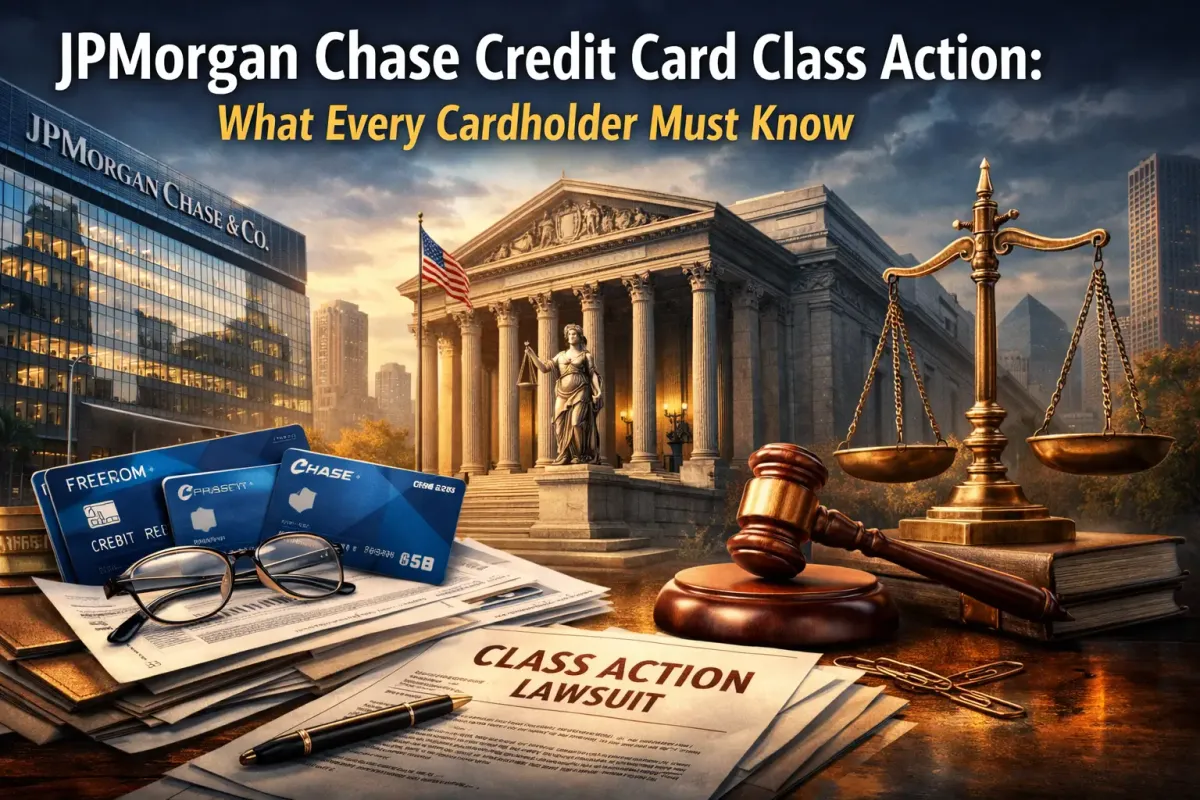
If you hold a JPMorgan Chase credit card, you may be owed money. From 2024 through early 2026, JPMorgan Chase has faced a wave of serious class action lawsuits — covering fraudulent membership credits, zombie debt sales, illegal robo-signing, and even alleged interest rate collusion spanning three decades. These are not small claims. Regulators, consumers, and courts across the country have all taken notice.
This guide breaks down every active JPMorgan Chase credit card class action you need to know about — what the allegations are, who qualifies, how past settlements paid out, and exactly what steps to take if you believe you've been wronged. Whether you're a Chase Sapphire holder, a Freedom cardholder, or simply someone who had credit card debt sold to collectors, the information here could directly affect your finances.
We've reviewed filings from federal courts, CFPB enforcement actions, and settlement records to bring you the most accurate and up-to-date picture available.
What Is the JPMorgan Chase Credit Card Class Action?
A class action lawsuit is a legal mechanism that allows a large group of people who have suffered similar harm from a single defendant to sue together as a collective. In the context of the JPMorgan Chase credit card class action lawsuits, millions of American cardholders are represented collectively in court — which means even if your individual loss was a few hundred dollars, you can still receive compensation without hiring your own attorney.
JPMorgan Chase is the largest bank in the United States by assets, according to Federal Reserve data. With tens of millions of credit card accounts, even a small systematic violation across the portfolio can affect an enormous number of consumers — making Chase a natural target for class action litigation.
The current wave of legal action covers several distinct categories of alleged misconduct:
- Fraudulent credit card membership charges — promising statement credits that were never applied
- "Zombie debt" sales — selling credit card debt to collectors that had already been paid, settled, or discharged in bankruptcy
- Robo-signed court documents — using illegally sworn affidavits in debt collection lawsuits
- Cash sweep program abuses — paying artificially low interest rates on swept investment account balances
- Interest rate fixing — allegedly colluding with six other major banks to fix prime rates for over 30 years
- ERISA violations — charging employees illegal tobacco surcharges on health insurance premiums
⚠️ Important Disclaimer This article is for educational and informational purposes only and does not constitute legal advice. If you believe you are affected by any of the lawsuits described here, consult a qualified attorney. JPMorgan Chase has denied wrongdoing in many of these cases, and all allegations remain unproven unless otherwise noted.
Active Class Action Cases in 2025–2026
Multiple lawsuits are simultaneously moving through federal courts right now. Here is a clear breakdown of each active case and what it means for Chase customers.
6+Active class action cases filed 2024–2026$216M+Total penalties & consumer refunds ordered in CFPB action528K+Consumer accounts Chase ordered to stop collecting on47States + D.C. that joined the CFPB enforcement action
Case 1: Fraudulent Credit Card Membership Credits (2025)
In September 2025, plaintiff John Sacchi filed a federal lawsuit in the Southern District of New York (Sacchi v. JPMorgan Chase Bank N.A., Case No. 1:25-cv-07632). The lawsuit alleges that Chase fraudulently induced consumers to purchase annual credit card memberships by promising automatic statement credits for restaurant and music streaming purchases — and then failed to deliver those credits.
According to the complaint, Sacchi paid $750 for a one-year Chase credit card membership in summer 2025, relying on Chase's promise that specific purchases would be automatically credited. Chase allegedly failed to apply those credits, forcing Sacchi to pay the charges out of pocket to avoid interest and penalties. The suit seeks class certification for all U.S. consumers who experienced the same bait-and-switch.
"The plaintiff alleges that this practice is part of a systematic plan by the company to induce consumers to pay for Chase credit card memberships and make specific purchases, only to deny them the promised credits." — Sacchi v. JPMorgan Chase Bank N.A., Court Filing, September 2025
Case 2: Interest Rate Fixing — Seven Major Banks (2025)
Filed in October 2025 in the U.S. District Court for the District of Connecticut (Normandin v. JPMorgan Chase, Case No. 3:25-cv-01749), this case names Chase alongside Bank of America, Wells Fargo, Citibank, U.S. Bank, PNC Bank, and Truist Bank. Plaintiffs Tracy Normandin and J. Allen Sensabaugh allege the banks colluded to fix, raise, and stabilize interest rates on consumer and small-business loans for more than three decades.
The complaint argues the conspiracy was facilitated by the Federal Reserve's 1994 decision to begin publishing explicit federal funds rate targets, which allowed the banks to peg prime rates in lockstep. Plaintiffs are seeking treble damages — meaning triple the actual overcharges — under federal antitrust law.
Case 3: Cash Sweep Program Abuses (2024)
Two separate class actions (filed in August and October 2024) target JPMorgan's cash sweep program for investment accounts. Both allege that J.P. Morgan Securities LLC automatically swept uninvested client cash into Chase Bank deposit accounts that paid "unreasonably" and "artificially" low interest rates — while JPMorgan and its affiliates kept the vast majority of the earnings from those deposits for themselves.
The lawsuits argue that JPMorgan Securities breached its contractual duty to put clients' interests first, and that account agreements deliberately failed to disclose the conflicts of interest or the interest rates customers would actually receive.
Case 4: ERISA Tobacco Surcharge Violation (2026)
Filed in January 2026 (Carmichael v. JPMorgan Chase & Co., Case No. 1:26-cv-00305), this lawsuit alleges Chase violated the Employee Retirement Income Security Act (ERISA) by imposing illegal surcharges on employee health insurance premiums based on tobacco use status. The plaintiff claims the surcharges unfairly penalized workers based on health status in violation of federal benefit law.
| Case Name | Filed | Court | Core Allegation | Status |
|---|---|---|---|---|
| Sacchi v. JPMorgan Chase | Sept 2025 | S.D.N.Y. | Fraudulent credit card membership credits | Pending |
| Normandin v. JPMorgan Chase | Oct 2025 | D. Conn. | Interest rate fixing (7 banks) | Pending |
| Canales v. JPMorgan Chase | Oct 2024 | C.D. Cal. | Cash sweep low interest rates | Pending |
| Unnamed v. JPMorgan Chase | Aug 2024 | S.D.N.Y. | Cash sweep program misrepresentation | Pending |
| Carmichael v. JPMorgan Chase | Jan 2026 | S.D.N.Y. | ERISA tobacco surcharge | Pending |
The CFPB's $216 Million Enforcement Action Against Chase
While the above lawsuits are still in progress, one of the most consequential enforcement actions against Chase has already concluded — and resulted in one of the largest consumer-protection penalties in recent banking history.
The Consumer Financial Protection Bureau (CFPB), along with attorneys general from 47 states and the District of Columbia, took formal action against JPMorgan Chase for two serious violations related to credit card debt: selling "zombie debts" and robo-signing court documents.
What Are "Zombie Debts"?
Zombie debts are old accounts that should no longer be collectable — because they were already paid, settled out of court, discharged in bankruptcy, fraudulent, or otherwise invalid. Chase sold these accounts to third-party debt buyers anyway. Those collectors then contacted consumers and filed lawsuits to collect debts that weren't legally owed.
According to the CFPB, Chase also sold debts owed by deceased borrowers and accounts with inaccurate balances — compounding the consumer harm.
Robo-Signing: What It Means and Why It Matters
When Chase — or the debt buyers it sold to — needed to file lawsuits to collect on defaulted credit card accounts, they were required to submit sworn affidavits verifying that the debt was accurate and owed. Instead, the CFPB found that Chase mass-produced these affidavits using robo-signing: employees were signing documents at a rapid industrial pace without actually reviewing the underlying account files.
This produced thousands of false or misleading sworn statements filed in courts across America, resulting in judgments against consumers for debts they might not have legally owed — or owed in amounts that weren't accurate.
📌 Enforcement Outcome Chase was ordered to pay at least $50 million in consumer refunds, $136 million in penalties and payments to the CFPB and states, and an additional $30 million penalty to the Office of the Comptroller of the Currency. The bank was also ordered to permanently stop collecting, enforcing, or selling more than 528,000 consumer accounts. Source: CFPB.gov
The $100 Million Minimum Payment Settlement: A Blueprint for What's Possible
One of the most important precedents in Chase credit card litigation happened over a decade ago — but it remains highly instructive for understanding how Chase class actions can resolve and pay out.
In November 2012, U.S. District Judge Maxine M. Chesney granted final approval of a nationwide $100 million settlement representing over one million Chase customers. The case centered on one key allegation: Chase had unilaterally changed the terms of fixed-rate credit card loans.
Chase had originally offered customers a fixed, low-interest balance transfer with a minimum monthly payment of 2% of the outstanding balance — promised to continue "until the balance is paid in full." Then, in late 2008 and mid-2009, Chase raised that minimum payment to 5% — more than doubling customers' required monthly payments with no legal justification, according to plaintiffs.
"Chase unilaterally changed the terms of the loans by increasing the monthly minimum payment from 2% to 5%, more than doubling customers' monthly payments." — Class Law Group, Case Summary
For many customers on fixed incomes or tight budgets, this sudden doubling of their minimum payment caused serious financial hardship. The case demonstrated that banks cannot simply rewrite the terms of contracts that contain specific promises to customers — and that class action litigation can deliver meaningful compensation when they try.
Do You Qualify? How to Check Your Eligibility for a Chase Class Action
Eligibility varies significantly depending on which lawsuit or settlement is relevant to your situation. Use the questions below as a starting checklist.
You May Qualify for the Credit Card Membership Lawsuit If:
- You purchased or were enrolled in a Chase annual credit card membership program
- You made purchases that were supposed to generate automatic statement credits
- Those credits were not applied, and you had to pay the charges out of pocket
- This occurred with a JPMorgan Chase-issued credit card in the United States
You May Qualify for the Cash Sweep Lawsuit If:
- You held an investment account with J.P. Morgan Securities LLC
- Your uninvested cash was automatically transferred into a Chase Bank deposit account
- You received interest rates you believe were unreasonably low on those swept balances
- Your account was active any time from 2018 onward, particularly from March 2022 when the Fed began raising rates
You May Be Affected by the CFPB Zombie Debt Action If:
- You were contacted by a debt collector about an old Chase credit card debt
- The debt had already been paid, settled, discharged in bankruptcy, or wasn't yours
- You were sued by Chase or a debt buyer over a credit card account between 2009 and 2013
- A judgment was obtained against you for debt that you believe was inaccurate
✅ Quick Tip Pull your free annual credit reports at AnnualCreditReport.com. Under the Fair Credit Reporting Act (FCRA), you're entitled to free reports from Equifax, Experian, and TransUnion. Look for any Chase accounts, debt sales, or collection activity that looks suspicious or incorrect.
How to File a Claim or Join a JPMorgan Chase Class Action Lawsuit
The process for joining a class action is generally simpler than most people expect. You usually do not need to hire a lawyer or pay any upfront fees. Here is a step-by-step guide.
1. Identify the Relevant Lawsuit
Review the active cases listed above and determine which one — if any — applies to your situation with Chase. Each lawsuit has its own class definition and eligibility criteria.
2. Gather Your Documentation
Collect all relevant records: credit card statements, membership agreements, correspondence from Chase or debt collectors, and any court documents if you were sued. The more evidence you have, the stronger your position.
3. Monitor Class Action Notification Databases
Check resources like TopClassActions.com and ClassAction.org regularly. When a settlement is approved, class members receive notice by mail or email with instructions on how to submit a claim form.
4. Submit Your Claim Form Before the Deadline
Once a settlement is reached and a claim form is available, complete it accurately and submit it before the deadline. Missing the deadline typically means forfeiting your right to compensation.
5. Consider Consulting a Consumer Rights Attorney
If your individual losses are significant, or if you were sued by Chase or a debt collector, consider consulting a consumer rights or class action attorney. Many offer free consultations and take cases on contingency — meaning you pay nothing unless you win. See the CFPB's debt collection resources for guidance.
6. File a Complaint with the CFPB
Even if you're not part of a formal class action, filing a complaint at consumerfinance.gov/complaint creates a formal record of your experience. The CFPB uses these complaints to build enforcement cases — your complaint may directly contribute to future regulatory action.
⏰ Time-Sensitive Warning Statutes of limitations apply to consumer fraud and credit card lawsuits. Depending on your state and the specific claim type, you may have as little as 2–6 years from the date of the violation to take legal action. Do not delay.
Your Consumer Rights Against Chase — Laws That Protect You
Multiple federal and state laws give consumers powerful tools to fight back against abusive credit card and debt collection practices. Understanding these laws is the first step to asserting your rights.
The Fair Debt Collection Practices Act (FDCPA)
The FDCPA prohibits debt collectors from using abusive, deceptive, or unfair practices. If a third-party collector contacted you about a Chase debt that was already paid or settled, or used harassing tactics, you may have a claim under the FDCPA — entirely separate from any class action.
The Fair Credit Reporting Act (FCRA)
The FCRA governs how your credit information is collected, used, and shared. In the past, JPMorgan Chase paid $8.75 million to settle an FCRA class action alleging it accessed consumer credit reports without proper authorization — impacting people who had already closed their Chase accounts. Under the FCRA, you have the right to dispute inaccurate information on your credit report, and the bureau must investigate and remove invalid entries.
The Truth in Lending Act (TILA)
TILA requires credit card issuers to clearly disclose interest rates, fees, and terms. Unilateral changes to credit card terms — like raising minimum payment requirements mid-contract — can constitute violations of TILA and related regulations. This is exactly the kind of conduct that generated the $100 million class action settlement described above.
The Dodd-Frank Act and CFPB Authority
The Consumer Financial Protection Bureau was created by the Dodd-Frank Act specifically to protect consumers from unfair, deceptive, or abusive acts and practices (UDAAP) by financial institutions. The CFPB's enforcement action against Chase for zombie debts and robo-signing was grounded in Dodd-Frank's UDAAP prohibitions — and resulted in over $216 million in penalties and consumer relief.
State Consumer Protection Laws
Every state has its own consumer protection statutes that can provide additional remedies beyond what federal law allows. Many of the lawsuits against Chase include state law claims — which is why the interest rate fixing case was filed in Connecticut and the CFPB action was joined by 47 state attorneys general.
Chase Class Action Settlement History and What You Can Expect to Receive
How much can class members actually expect to receive from a Chase class action settlement? History gives us several data points — though actual payouts vary enormously based on the size of the settlement fund and the number of eligible claimants.
| Settlement / Case | Year Finalized | Settlement Amount | Nature of Claim | Approx. Payout Per Person |
|---|---|---|---|---|
| Minimum Payment Increase | 2012 | $100 million | Unilateral loan term changes | Varied by account balance |
| FCRA Unauthorized Credit Inquiries | 2016 | $8.75 million | Unauthorized credit report access | ~$8.93 per claimant |
| Payment Protection Products | 2011 | Undisclosed | Deceptive payment protection enrollment | Variable |
| CFPB Zombie Debt Enforcement | Settled | $50M+ refunds, $136M+ penalties | Zombie debt sales, robo-signing | Variable; 528K+ accounts cancelled |
The FCRA settlement payout of approximately $8.93 per person might seem small, but it's worth noting: class members were required to do nothing more than submit a simple claim form. No legal fees, no attorney, no court appearances. For cases involving larger individual losses — like the minimum payment settlement — payments were proportional to the actual financial harm suffered.
The active 2025–2026 cases involving credit card membership credits, interest rate fixing, and cash sweep abuses have not yet settled. If history is a guide, settlements in those cases could range from millions to over $100 million depending on how broadly the class is defined and how strong the evidence is.
Expert Advice: What Consumer Attorneys Say About Taking on Chase
Consumer protection attorneys who have litigated cases against major banks — including JPMorgan Chase — share several consistent pieces of advice for affected consumers.
Document Everything, Immediately
Attorney Eric Gibbs, who represented plaintiffs in the $100 million Chase minimum payment class action and was nominated for the Consumer Attorneys of California's 2013 Consumer Attorney of the Year award for that work, has emphasized that meticulous record-keeping is essential. Statements, correspondence, and transaction records are the evidentiary backbone of any class action claim.
Don't Ignore Collection Lawsuits
Legal data consistently shows that over 70% of credit card debt lawsuits end in default judgments simply because consumers fail to respond within the filing deadline, according to research cited in consumer law publications. A default judgment gives the creditor nearly everything they asked for — including potential wage garnishment and property liens — without you ever presenting a defense.
If Chase or a debt buyer sues you, you typically have 14 to 30 days (depending on your state) to file a written Answer with the court. Missing that window is almost always catastrophic.
Check Your Card Agreement for Arbitration Clauses
Many Chase credit card agreements include mandatory arbitration clauses, which can affect whether you participate in a class action or must resolve disputes individually. However, courts have sometimes found these clauses unenforceable in consumer fraud contexts, and some class action attorneys specifically argue against their application. Review your agreement carefully — and ask an attorney if you're unsure.
Use the Arbitration Clause as a Defense Tool
Interestingly, if Chase or a debt buyer sues you, filing a Motion to Compel Arbitration removes the case from public court. Arbitration costs the bank significant money and time — which is why many collectors drop cases entirely rather than proceed through the process.
📞 Free Resources The CFPB offers free consumer financial tools at consumerfinance.gov/consumer-tools. The National Consumer Law Center (nclc.org) publishes free guides on credit card rights. The American Bar Association's Find-a-Lawyer tool at americanbar.org can help you locate a consumer rights attorney in your state.
Conclusion: Key Takeaways for JPMorgan Chase Cardholders
The JPMorgan Chase credit card class action landscape in 2025 and 2026 is complex, multi-front, and potentially very significant for millions of American consumers. Here is what you should walk away knowing:
- Multiple active lawsuits are currently working through federal courts targeting Chase for credit card membership fraud, interest rate fixing, cash sweep abuses, and ERISA violations.
- The CFPB and 47 state AGs already reached a landmark enforcement order requiring Chase to pay over $216 million and permanently stop collecting on more than 528,000 consumer accounts.
- Chase has a history of large class action settlements — the $100 million minimum payment settlement established that courts will hold the bank accountable for unilateral, harmful contract changes.
- You may qualify if you purchased a Chase credit card membership and didn't receive promised credits, if your Chase investment cash was swept at artificially low rates, or if you were pursued for a Chase debt that was already paid or shouldn't have been collectible.
- Time is critical — statutes of limitations apply, and if you've been sued by Chase or a collector, you typically have just 14–30 days to respond before a default judgment is entered against you.
- Your rights are real — the FDCPA, FCRA, TILA, and Dodd-Frank all provide meaningful protections. You do not have to be a passive victim of banking misconduct.
If any of the situations described in this article sound familiar, take action today. File a CFPB complaint, pull your credit reports, consult a consumer attorney, and monitor settlement databases for claim deadlines. The legal system has already demonstrated, multiple times, that it will hold JPMorgan Chase accountable when it harms consumers — but only consumers who show up to claim what they're owed actually receive it.
Were You Harmed by JPMorgan Chase?
Don't let statute of limitations deadlines expire. File a free complaint with the CFPB, check your eligibility with a consumer attorney, and monitor open class action claims — all at no cost to you.
Frequently Asked Questions
What is the JPMorgan Chase credit card class action lawsuit about?
There are multiple active JPMorgan Chase credit card class action lawsuits in 2025–2026. They cover allegations including fraudulent credit card membership charges (where Chase promised automatic statement credits but failed to apply them), selling "zombie debts" to collectors, robo-signing court documents, abusing cash sweep investment programs, and allegedly colluding with six other major banks to fix consumer interest rates for over 30 years.
How do I know if I qualify for a JPMorgan Chase class action?
Eligibility depends on the specific lawsuit. For the credit card membership lawsuit, you may qualify if you purchased a Chase annual credit card membership and didn't receive promised statement credits. For the cash sweep lawsuit, eligibility extends to J.P. Morgan Securities investment account holders. For the zombie debt enforcement, it covers people who were pursued for debts that were already paid or discharged in bankruptcy between 2009 and 2013.
How much money could I receive from a Chase class action settlement?
Payouts vary widely. The 2016 FCRA settlement paid approximately $8.93 per claimant. The 2012 minimum payment settlement distributed proportional shares of a $100 million fund. Active 2025–2026 cases have not yet settled. Your payment depends on the total settlement fund approved by the court and the total number of eligible class members who submit claims.
Do I need a lawyer to join a Chase class action lawsuit?
For most class actions, no. You simply submit a claim form when one becomes available. However, if your individual losses are substantial, if you were personally sued by Chase or a debt buyer, or if you want a more active role in the litigation, consulting a consumer protection attorney — many offer free consultations on contingency — is advisable.
What should I do if Chase or a debt collector is suing me over a credit card debt?
Do not ignore the summons. You have 14–30 days (by state) to file a written Answer. Failure to respond nearly always results in a default judgment, potentially enabling wage garnishment. After filing, consult a debt defense attorney, verify the debt's accuracy and whether the statute of limitations has passed, and file a CFPB complaint if the debt appears inaccurate. Research shows more than 70% of credit card debt cases end in default simply because consumers don't respond.