Noble Credit Union: How to Close a Credit Card Without Wrecking Your Credit
You've made the decision. You want to close your Noble Credit Union credit card — maybe because of unused fees, simplifying your wallet, or just getting a fresh financial start. The problem? Nobody tells you the exact steps, and one wrong move can quietly ding your credit score for months.
This guide walks you through the complete process of closing a Noble Credit Union credit card — from zeroing your balance to getting written confirmation of closure. We also cover what the credit bureaus will see, what you should do before you call, and when canceling a card is actually the wrong move for your financial health.
Whether you're a longtime member or recently joined, this is the only guide you'll need.
About Noble Credit Union Credit Cards

Noble Credit Union is a federally-chartered credit union serving members across California's Central Valley. Like most credit unions, Noble prides itself on lower interest rates, fewer fees, and a member-first model compared to big commercial banks.
Noble offers credit cards with competitive APRs and flexible credit limits. Their cards are issued under the Visa network, which means they're accepted globally — but that convenience comes with annual fees and ongoing credit utilization implications if left open and unused.
Understanding Noble's specific closure policies matters because, unlike large national banks that allow self-service digital closures, most credit unions — Noble included — require direct member communication. Let's start with the most critical preparation phase.
What to Do Before You Close Your Card

Rushing into a closure without preparation is the most common mistake people make. Here's your pre-closure checklist — every item here protects either your money or your credit score.
1. Pay Off Your Full Balance
This is non-negotiable. Noble Credit Union will not close a card that carries an outstanding balance. Even a $3 residual charge from a pending transaction can stall the entire process.
Watch Out Pending transactions can post after you think your balance is zero. Wait 5–7 business days after your last purchase before checking your final payoff amount.
2. Redeem All Rewards Points
If your Noble credit card carries a rewards program or cashback structure, every unredeemed point is forfeited the moment the account closes. Log in to your Noble member portal, navigate to your rewards dashboard, and redeem anything with value — even for statement credits.
3. Cancel Recurring Automatic Payments
This is the step most people forget. Subscription services billed to your Noble card — Netflix, gym memberships, insurance premiums — will fail to process after closure. Update your payment method on file for every recurring service before submitting the closure request.
- List all subscriptions linked to the card
- Update each to a new payment method
- Allow one full billing cycle before closing
- Download your last 12 months of statements for records
4. Check Your Credit Utilization Ratio
Before closing, calculate what your credit utilization will look like afterward. Credit utilization — the percentage of your total available credit you're using — accounts for approximately 30% of your FICO score, according to myFICO's credit score breakdown.
How to Close Your Noble Credit Union Credit Card (Step-by-Step)
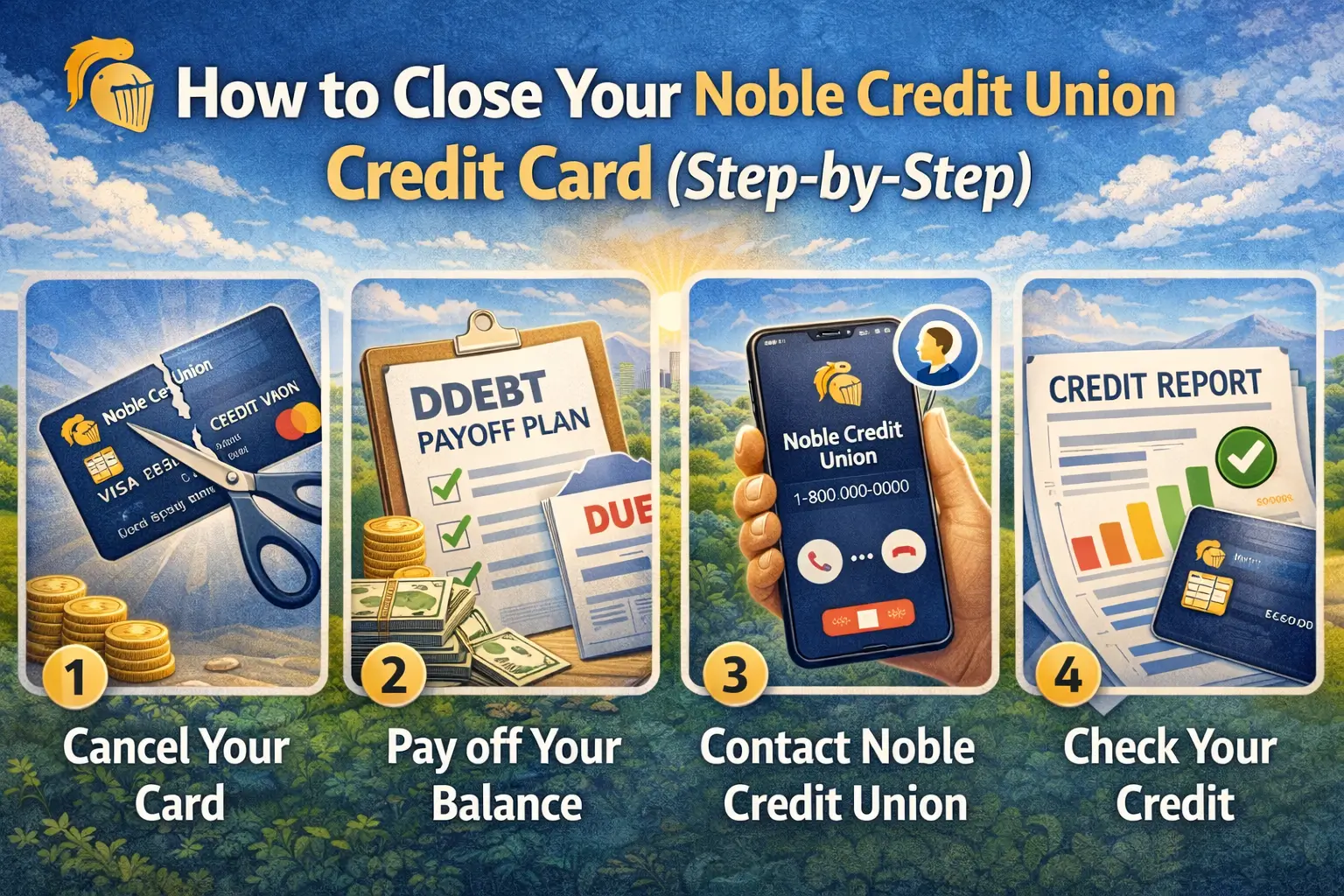
Noble Credit Union does not offer a direct online self-service closure option as of 2025. Here are your three official channels — choose the one that works best for you.
Method 1: Close by Phone (Fastest)
Calling Noble's member services line is the most efficient way to close your account. Here's exactly how to handle the call.
-
1
Call Noble Credit Union Member Services
Dial Noble's main member services number. Have your member ID, Social Security number (last 4 digits), and card number ready for identity verification.
-
2
State your intent clearly
Tell the representative: "I'd like to permanently close my credit card account ending in [XXXX]." Be direct — representatives may attempt to retain you with offers. You're not obligated to accept.
-
3
Confirm zero balance
The representative will verify your balance is $0. If any pending transactions exist, they'll inform you to call back once they clear.
-
4
Request a closure confirmation number
Before you hang up, ask for a reference or confirmation number for your closure request. Write it down — you'll need it if the closure is disputed later.
-
5
Request written confirmation
Ask Noble to send you a written closure confirmation by mail or email. This is your official proof that the account was closed at your request — not due to default or delinquency.
Method 2: Close In Person at a Branch
If you prefer face-to-face service, visit any Noble Credit Union branch with your government-issued photo ID and credit card in hand. A member service representative will process your closure request directly. Some members prefer this method because it allows them to physically cut the card in front of the representative and receive same-day written documentation.
Pro Tip Visiting a branch gives you the opportunity to discuss alternatives — like a credit limit reduction or temporary card suspension — if you're unsure about permanent closure. It's also faster for processing final confirmation.
Method 3: Written Request by Mail
For members who prefer a paper trail from the start, you can mail a formal written closure request to Noble Credit Union's mailing address. Include:
- Your full legal name and member ID
- The credit card account number you wish to close
- A statement requesting permanent account closure
- Your signature and date
- A request for written confirmation of closure
Mail processing typically takes longer — allow 10–21 business days. Send via certified mail to confirm receipt.
Comparing Your Closure Methods
| Method | Speed | Confirmation | Best For |
|---|---|---|---|
| Phone Call | 1–3 business days | Verbal + follow-up letter | Most members |
| In Person (Branch) | Same day | Written on the spot | Members wanting certainty |
| Written Mail | 10–21 business days | Mailed response | Documentation-focused members |
How Card Closure Affects Your Credit Score
Closing a Noble Credit Union credit card is a legitimate financial decision — but it isn't credit-neutral. Here's an honest breakdown of what happens to your credit profile.
Credit Utilization Goes Up
When you close a card, you lose that card's credit limit from your total available credit. If you're currently carrying balances on other cards, your utilization ratio increases immediately. For example: if you have $2,000 in balances across $10,000 in total limits, that's 20% utilization. Close a card with a $3,000 limit and your available credit drops to $7,000 — pushing your utilization to nearly 29%.
Credit History Length May Shorten
Closed accounts do stay on your credit report — but only for up to 10 years, according to the Consumer Financial Protection Bureau. After that, the account and its positive history disappear entirely. If this Noble card was your oldest account, closing it could eventually reduce your average account age, lowering your score.
What Doesn't Change
Your payment history — the most heavily weighted FICO factor at 35% — is not affected by closure. Any on-time payments you made on this card remain on your credit report and continue to benefit your score for years.
Expert Insight According to FICO's official guidance, the impact of closing a single card is "generally small" for consumers with multiple accounts and healthy utilization across remaining cards. The risk is highest for those with limited credit history or few open accounts.
Smart Alternatives to Closing Your Card
Before you finalize your decision, it's worth asking: is there a smarter move here? Closing a card is irreversible. These alternatives can solve the same problem without the credit score hit.
Request a Credit Limit Reduction
If you're worried about overspending on a high-limit card, ask Noble to lower your credit limit rather than close the account. You keep your credit history and account age intact while reducing temptation.
Downgrade to a No-Fee Card
If your primary reason for closing is the annual fee, ask Noble if they offer a fee-free version of the card you can be downgraded to. This is called a "product change" and it preserves your account history entirely.
Request a Temporary Account Freeze
Some credit unions allow members to temporarily freeze or suspend a credit account without formally closing it. Contact Noble directly to ask whether this option is available on your account.
Simply Stop Using It
If the card has no annual fee, the simplest option is to stop using it. Make one small recurring charge — a $5/month streaming service — set it on autopay, and leave the account open. This preserves credit history and keeps utilization low, completely passively.
What to Do After Your Card Is Closed
Closure isn't the finish line — the few steps you take afterward are critical for protecting yourself financially and legally.
Monitor Your Credit Report
Within 30–60 days of closure, check your credit reports at AnnualCreditReport.com — the only federally authorized free credit report provider. Confirm the Noble account is listed as "Closed — at consumer's request." This distinction matters: an account listed simply as "Closed" without that notation can sometimes imply issuer-initiated closure due to delinquency.
Dispute Any Errors
If the credit bureau listing is inaccurate — wrong balance, wrong closure date, wrong closure reason — file a formal dispute with the relevant bureau (Equifax, Experian, or TransUnion) immediately. Under the Fair Credit Reporting Act (FCRA), bureaus must investigate and respond within 30 days.
Physically Destroy Your Card
Cut your Noble credit card through the chip and magnetic strip before disposal. If it has contactless tap-to-pay capability, a single cut through the card is sufficient to disable it. Don't just throw it in the trash intact.
Keep Your Closure Documentation
Store the written closure confirmation Noble provides for a minimum of 7 years. This document is your defense against any future disputes, erroneous balance claims, or identity theft scenarios tied to the old account number.
Ready to Take the Next Step?
Bookmark this guide, complete your pre-closure checklist, and contact Noble Credit Union member services when you're ready. A little preparation now saves months of credit score headaches later.
Visit Noble Credit Union →