AVA Credit Card Review 2026: Features, Fees & Is It Worth It?
If you have no credit history — or a damaged one — getting approved for a traditional credit card feels like a catch-22. You need credit to build credit. The AVA Credit Builder Card tries to break that cycle with a no-credit-check, no-security-deposit approach that reports your activity to all three major credit bureaus.
But is AVA actually worth the monthly membership fee? And how does it compare to free alternatives like Kikoff or banking-based options like the Chime Credit Builder?
This review covers everything you need to know about the AVA Credit Card in 2026: how it works, what it costs, who it helps, and where it falls short.
Quick Summary: AVA Credit Card at a Glance
| Feature | Details |
|---|---|
| Issuing Bank | Evolve Bank & Trust |
| Annual Percentage Rate (APR) | 0% (balance paid in full) |
| Membership Fee | $8/month (annual) or $10/month (monthly) |
| Security Deposit | None required |
| Credit Check | No hard inquiry |
| Credit Limit | Up to $2,500 |
| Bureau Reporting | Experian, Equifax, TransUnion (weekly) |
| Cashback Rewards | None |
| Spending Restrictions | Eligible subscriptions and Ava store only |
What Is the AVA Credit Card?
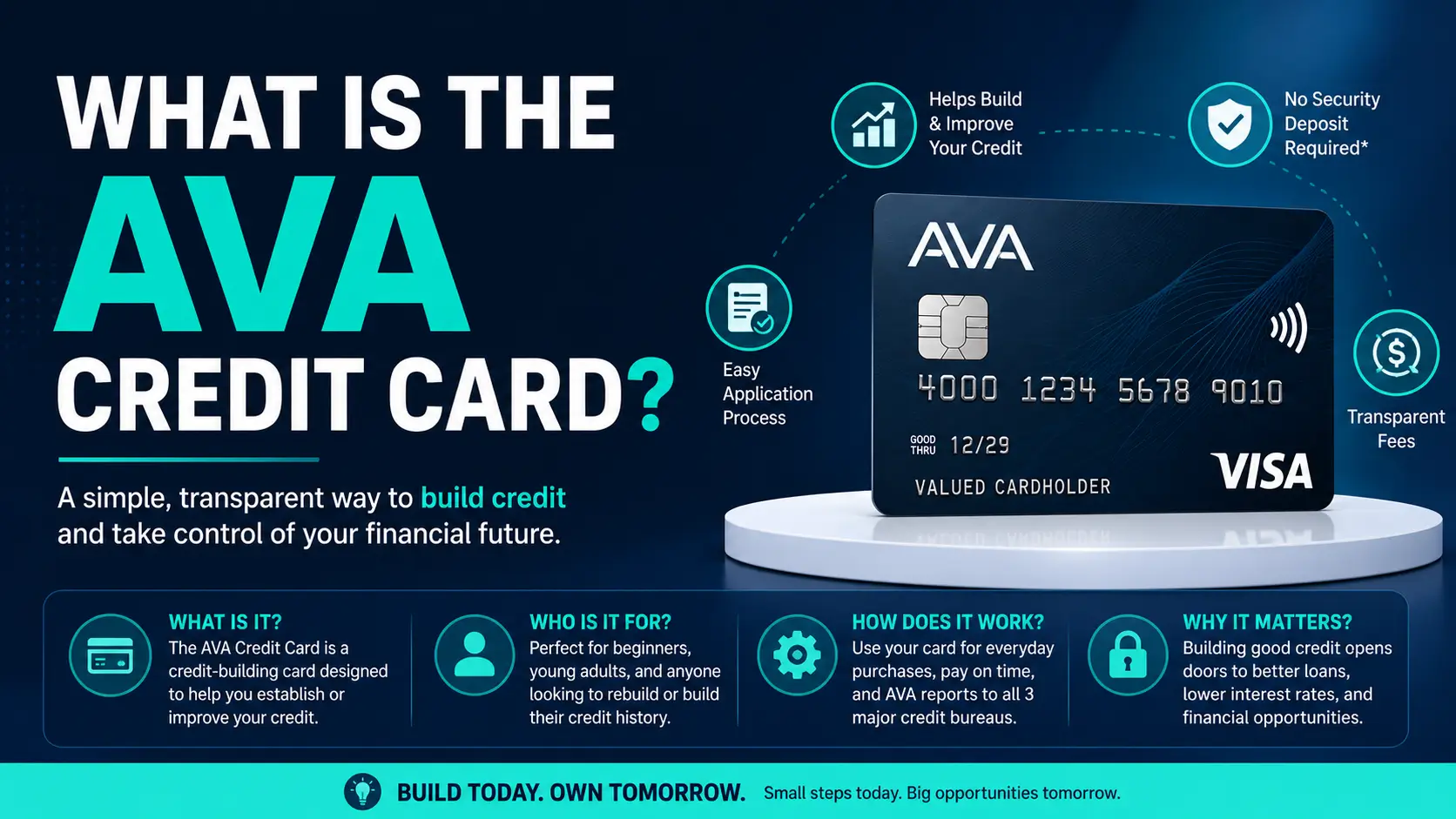
The AVA Credit Builder Card is a fintech product backed by Evolve Bank & Trust and issued through the AVA platform. It is specifically designed for people with no credit history, thin credit files, or low scores who cannot qualify for mainstream credit cards.
AVA is not a traditional credit card in the conventional sense. You cannot walk into a store and use it freely for everyday purchases. Instead, the card is limited to eligible recurring subscription payments — think streaming services, phone bills, and memberships — and purchases from the Ava store. This narrow spending scope is intentional: it creates a predictable, automated payment cycle that consistently improves two of the most critical FICO score factors — payment history (35% of your score) and credit utilization (30% of your score).
What makes AVA stand out in the credit-builder category is that the card is just one piece of a three-product suite. Users on the platform also have access to the Save and Build loan (a credit-builder installment loan) and rent reporting — meaning a single AVA membership can generate multiple tradelines across your credit profile simultaneously.
How the AVA Credit Card Works
Spending Structure
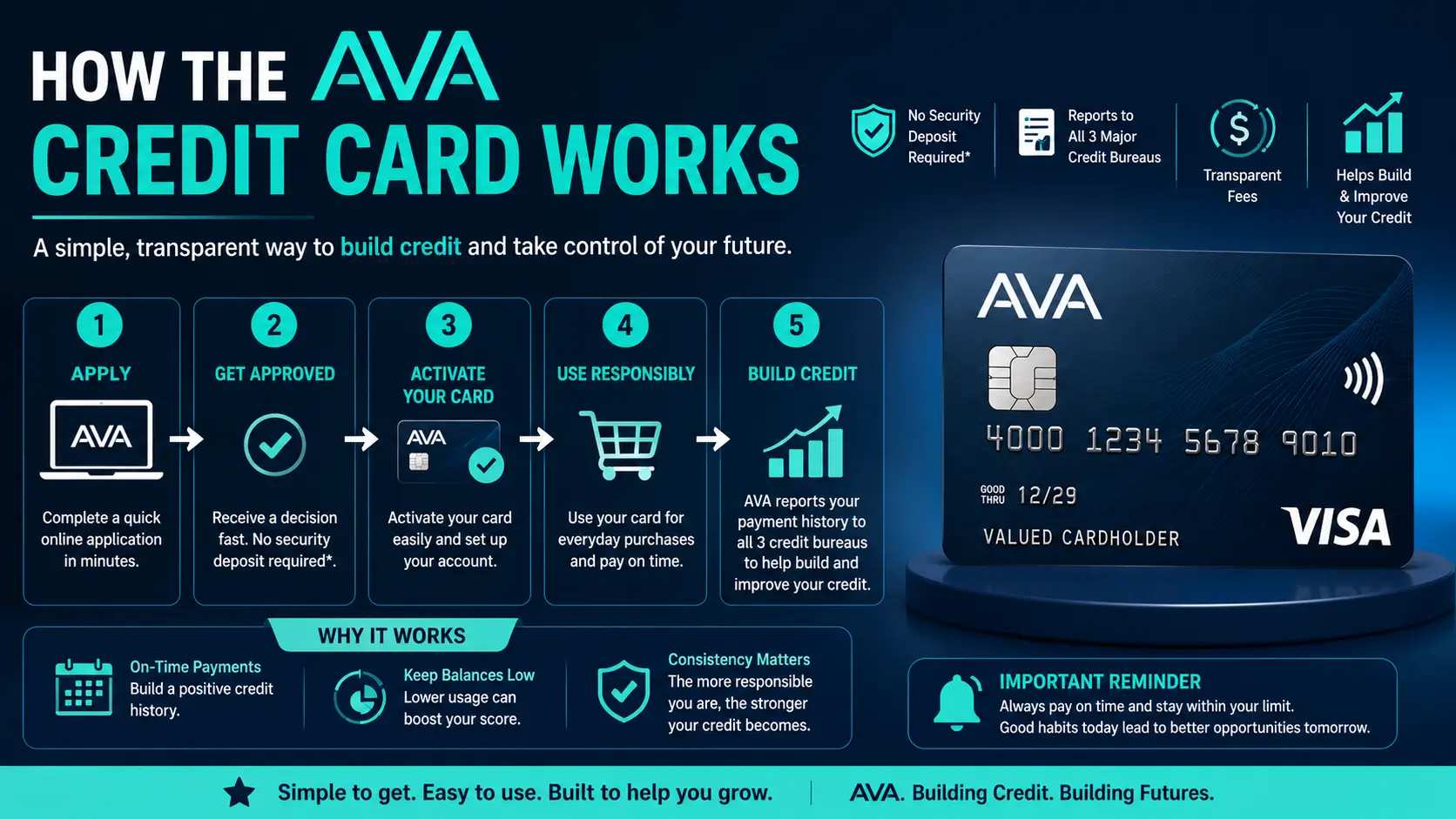
Once approved, the AVA card is linked to your eligible recurring subscriptions. The actual monthly spending is typically low — often starting around $5 per month — though the card carries a stated revolving credit limit of up to $2,500. This keeps your utilization extremely low relative to your credit limit, which is favorable for your credit score.
You cannot use the card for general retail, grocery, gas, or dining purchases. If your goal is a card for everyday spending, AVA is not it. But if your goal is purely to build credit with minimal risk of overspending, the restriction actually works in your favor.
Payment Structure
Balances on the AVA card must be paid in full each cycle. Payments are automatically withdrawn from your linked bank account, with each charge due 7 days after it posts. This automated, short repayment cycle is a core design feature — it nearly eliminates the risk of a missed payment, which would damage the credit score you're trying to build.
There is no interest charged because you never carry a balance. This also means there is no APR to worry about — the only cost you pay is the monthly membership fee.
Bureau Reporting
AVA reports your account activity to all three major credit bureaus — Experian, Equifax, and TransUnion — and it does so weekly, not monthly. Most traditional credit cards and credit-builder products report once a month. Weekly reporting means your on-time payment history and low utilization appear on your credit file faster, which can accelerate score improvements for new users who are establishing a credit profile from scratch.
AVA Credit Card Fees
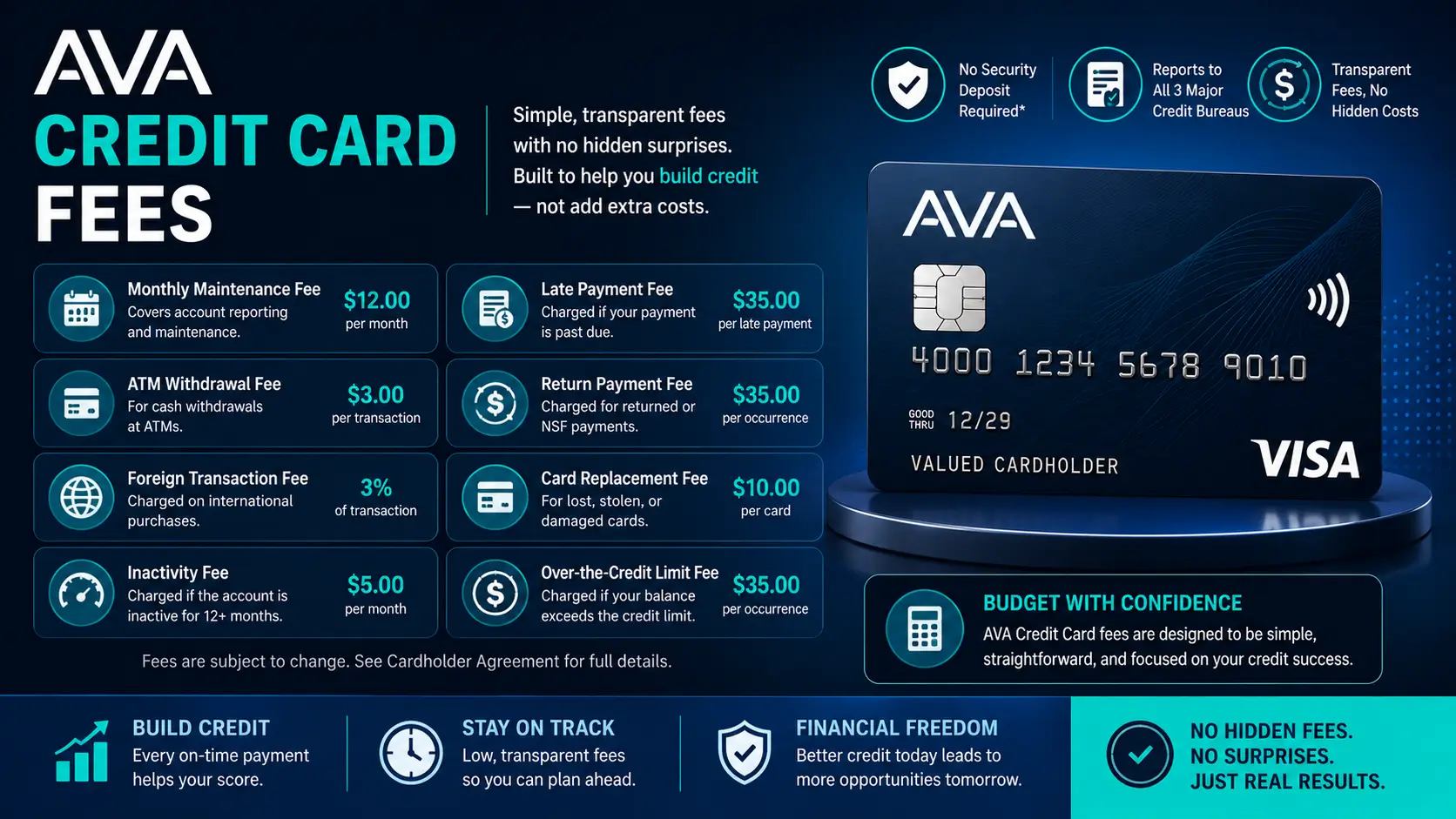
AVA is not free, and this is one of its most important considerations.
- Annual plan: $8 per month (billed annually at $96/year)
- Monthly plan: $10 per month
There are no late fees, no over-limit fees, and no foreign transaction fees. There is no interest charge because the card requires full-balance payment. The membership fee covers access to all AVA products — the credit card, the Save and Build loan, and rent reporting — so you're not paying $8 just for the card alone.
Over a 12-month period, you will pay between $96 and $120 for AVA membership. Whether this is "worth it" depends on how much value you place on building credit faster versus using a free alternative. For someone who has been denied for apartments, auto loans, or better credit cards due to a thin file, $96/year is a modest investment to unlock better financial products down the road.
AVA Save and Build Loan
In addition to the credit card, AVA offers a credit-builder installment loan called the Save and Build loan. Here's how it works:
- You commit to $25 per month for 12 months
- Each payment is reported as an on-time installment loan payment to all three bureaus
- At the end of the 12-month term, you receive the full $300 back — effectively forced savings
This loan serves two credit-building purposes simultaneously: it adds installment loan payment history to your credit profile and improves your credit mix (another FICO factor). Because most credit-builder card users only have revolving accounts, adding an installment tradeline through the loan strengthens the overall profile composition.
Note: An origination fee may apply in some states, so verify current terms at the time of application.
Rent Reporting with AVA
Rent is typically the largest monthly payment most people make — yet for most renters, it never appears on their credit report. AVA addresses this through rent reporting, which takes your on-time rent payments and reports them to Experian, Equifax, and TransUnion.
For renters with thin credit files, this is a significant benefit. Every month you pay rent on time but it doesn't hit your credit report is a missed opportunity to build payment history. AVA's rent reporting converts that existing habit into a positive tradeline without requiring any new debt or spending behavior.
Credit Score Impact: How Much Can AVA Raise Your Score?
Results vary by individual, but AVA reports that 74% of members see a credit score increase within the first week of membership. Some users have reported increases of 35 to 50 points within a few months, particularly those starting from a thin file or score below 600.
The factors driving score improvement with AVA are:
- Payment history — consistent, automated on-time payments on the card and loan
- Credit utilization — very low utilization relative to the $2,500 limit
- Credit mix — both revolving (card) and installment (loan) tradelines
- New accounts — adding tradelines to a thin profile
- Rent reporting — housing payment history added to the file
These improvements are real and meaningful, but they come with an important caveat: AVA is a starting point, not a destination. Once your credit score improves, the goal should be to graduate to a traditional credit card with rewards, higher limits, and full spending flexibility.
Pros of the AVA Credit Card
No hard credit check. AVA uses a soft inquiry only, so applying will not lower your credit score. Anyone regardless of credit history can apply.
No security deposit. Many credit-builder cards require you to lock up $200–$500 as collateral. AVA requires no deposit, making it accessible when you don't have extra cash to tie up.
Three-bureau weekly reporting. Most credit-builder products report to one or two bureaus, monthly. AVA's weekly three-bureau reporting is a genuine differentiator that accelerates profile building.
Multiple tradelines from one membership. The card (revolving), loan (installment), and rent reporting (housing) create up to three distinct tradelines from a single $8/month product.
Zero interest charges. Because balances are paid automatically and in full, you will never owe interest. The cost is flat and predictable.
High stated credit limit. The $2,500 revolving limit is generous for a credit-builder product. Even if your actual spending is only $5–$10/month, having a $2,500 limit keeps utilization near zero, which is optimal for your score.
Cons of the AVA Credit Card
Monthly membership fee. Free alternatives like Kikoff's basic plan or the Chime Credit Builder exist. If budget is your primary concern, paying $8–$10/month to build credit is not necessary — though AVA does offer more features than most free options.
Severely restricted spending. The card can only be used for eligible recurring subscriptions and AVA store purchases. This is not a card for everyday use. If you want a card that also functions as a payment tool, you'll need something else alongside AVA.
No cashback or rewards. You build credit, but you earn nothing on your spending. Cards like the Current Build Card offer 1 point per dollar on dining and groceries with no monthly fee.
No upgrade path. AVA does not have a graduation track to a traditional rewards card. Once your credit improves, you will need to apply elsewhere. This is a limitation compared to programs like Self's Secured Visa, which is tied to a credit-builder loan with an upgrade structure.
Long-term commitment required. The Save and Build loan is a 12-month product. Missing payments would hurt the credit score you're trying to build. This is only a risk if you have inconsistent income, but worth noting for those in volatile financial situations.
AVA Credit Card vs. Top Alternatives (2026)
| AVA | Kikoff | Chime Credit Builder | Self Visa | |
|---|---|---|---|---|
| Monthly Fee | $8–$10 | $0 (basic) | $0 | $0 (first year) |
| Security Deposit | None | None | Required (from Chime balance) | $100 minimum |
| Hard Credit Check | No | No | No | No |
| APR | 0% | 0% | 0% | N/A (loan product) |
| Bureau Reporting | All 3 (weekly) | All 3 | All 3 | All 3 |
| Spending Flexibility | Subscriptions only | Kikoff store only | General use | General use |
| Rent Reporting | Yes | Yes (Premium) | No | No |
| Installment Loan | Yes | Yes (Premium) | No | Yes (core product) |
| Rewards | None | None | 1.5% (rotating, with Chime+) | None |
| Upgrade Path | No | No | No | Yes (Secured Visa) |
Choose AVA if you want maximum credit-building output from a single low-cost product and don't need spending flexibility. The combination of three tradelines from one $8/month membership is hard to match.
Choose Kikoff if cost is your top priority and you want the simplest, lowest-friction entry point. Kikoff's free basic plan reports to all three bureaus and charges nothing unless you want premium features.
Choose Chime Credit Builder if you're already banking with Chime and want a credit builder tied to your existing checking account with no additional monthly fee.
Choose Self if you want a structured path from credit-builder loan to a traditional Visa card over 12–24 months. Self is best for users who want an upgrade track built into the product.
Who Should Get the AVA Credit Card?
AVA is a strong option for these specific situations:
- Absolute beginners with no credit file who want to establish multiple tradelines quickly
- Recent immigrants navigating the U.S. credit system for the first time
- People recovering from past financial setbacks (bankruptcy, collections) who cannot qualify for traditional cards and want a no-deposit path forward
- Renters who are already paying rent on time every month but not getting credit for it
- Disciplined users who want automated, hands-off credit building without risk of overspending
AVA is not ideal if you want a card for daily purchases, if you're unwilling to pay a monthly fee, or if you need a product that graduates into a traditional rewards card.
How to Apply for the AVA Credit Card
The application process is straightforward:
- Download the AVA app on iOS or Android
- Create an account — basic personal information and identity verification
- Link your bank account — required for automated payment withdrawals
- Choose your membership plan — annual ($8/month) or monthly ($10/month)
- Select your products — card, loan, or rent reporting individually or in combination
- Begin using the card for eligible subscription charges
There is no hard credit pull at any stage. Approval is not based on your existing credit score, making this one of the most accessible credit-building products available.
Is the AVA Credit Card Worth It in 2026?
For most people exploring credit-builder options, the honest answer is: yes, with the right expectations.
AVA is not a replacement for a full-featured credit card. You can't use it at the grocery store, earn rewards, or build toward a premium card through AVA directly. But as a foundational credit-building tool, it delivers a meaningful combination of features — three-bureau weekly reporting, multiple tradelines, no deposit, no hard inquiry — for a cost that is modest relative to what a poor credit score costs you in higher interest rates, denied applications, and restricted financial access.
If you're paying $8/month and your credit score improves enough to qualify for a better auto loan rate or apartment, the ROI on that $96/year is enormous. That's the lens through which to evaluate AVA.
Frequently Asked Questions (FAQs)
Does the AVA credit card require a credit check?
No. AVA performs only a soft inquiry. Your current credit score does not affect approval.
Is there interest on the AVA credit card?
No. Because balances are paid in full automatically, there is no APR and no interest charged. You only pay the membership fee.
How much does AVA cost?
$8 per month on the annual plan (billed as $96/year) or $10 per month on a rolling monthly plan.
How fast can AVA raise my credit score?
AVA reports that 74% of members see score improvement within the first week. Sustained improvements of 35–50 points over a few months are reported by many users, though individual results vary based on your starting profile.
What makes AVA different from other credit builder cards?
AVA combines a revolving credit card, an installment loan, and rent reporting under a single membership — creating up to three tradelines simultaneously. Most competing products offer only one of these features.
Can I use the AVA card anywhere?
No. The AVA card is restricted to eligible recurring subscription services and the Ava store. It is not designed for general everyday spending.
Is AVA legit?
Yes. AVA is backed by Evolve Bank & Trust, an FDIC-insured institution. The product reports to all three major credit bureaus and is a legitimate credit-building tool, not a scam.
Final Verdict
The AVA Credit Card earns its place as one of the more compelling credit-builder options in 2026 — not because it does everything, but because it does what it promises: build credit fast, accessibly, and without requiring a security deposit or existing credit score.
The spending restrictions and monthly fee are real drawbacks worth acknowledging. If you're looking for free and simple, Kikoff is the better choice. But if you want the most credit-building firepower from a single low-cost product — especially if you're renting and not getting bureau credit for those payments — AVA's three-in-one approach is hard to beat.
Bottom line: Use AVA as a launchpad. Build your score to 670+, then graduate to a rewards card that works for everyday spending.
Disclosure: This review is for informational purposes only. Credit-building results vary by individual. Always verify current fees and terms directly with AVA before applying.