MacKenzie Scott College Roommate Loan: What We Know About the Story
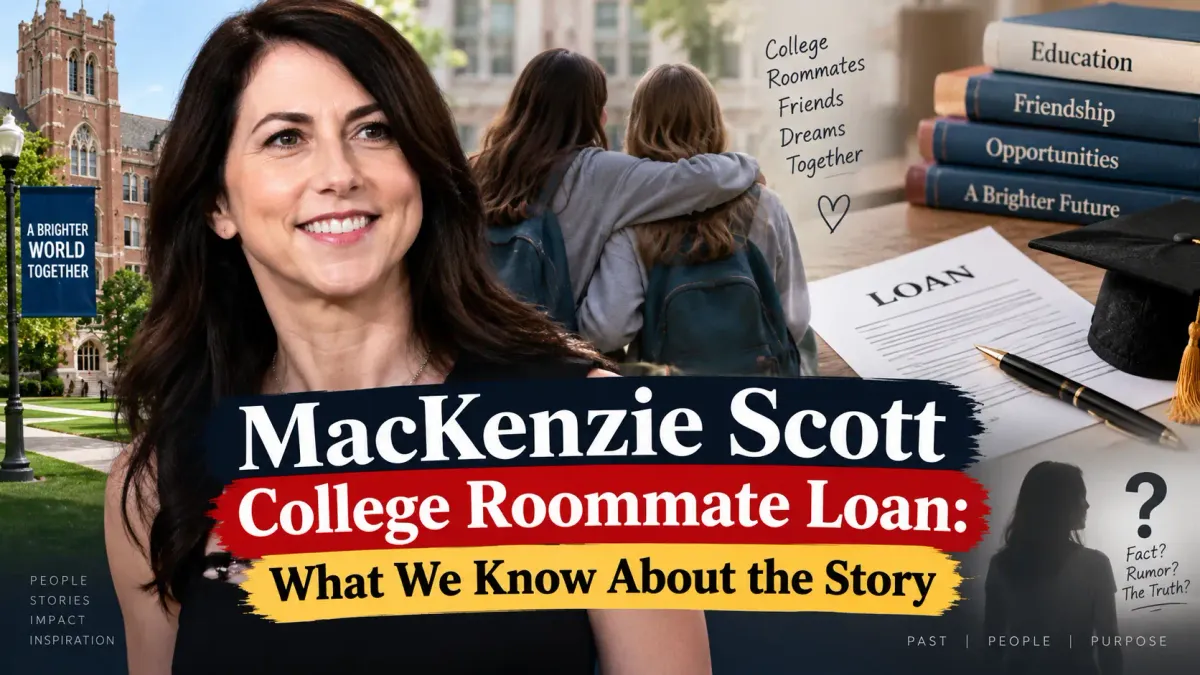
MacKenzie Scott has given away more than $19 billion since her 2019 divorce from Amazon founder Jeff Bezos, and she's done it almost entirely without press conferences, naming rights, or strings attached. So when she wrote, in an October essay on her giving platform Yield Giving, that her philanthropy traces back to a $1,000 loan from her Princeton roommate, it made headlines for a reason: it's a rare glimpse into how one of the world's most private billionaires thinks about generosity.
Here's what actually happened, who her roommate turned out to be, and — because this is a story about a loan — what it means if you're a student weighing your own borrowing options right now.
The story, in Scott's own words

In her essay, Scott described a moment during her sophomore year at Princeton when she was close to dropping out over $1,000 she didn't have. She wrote that it was her roommate who found her crying and, on instinct, loaned her the money to keep her enrolled.
Scott framed it as one of several small kindnesses — she also mentioned a dentist who once treated her for free — that she says she thinks about every time she makes a gift through Yield Giving.
Who the roommate actually is

Scott didn't name her in the essay, but reporting from the Associated Press and Fortune identified her as Jeannie Ringo Tarkenton, Scott's Princeton roommate and now the founder of a student lending company called Funding U.
There's a small but telling wrinkle here worth flagging, because it's missing from most of the coverage: Scott's essay credits "the college roommate" with the loan itself, while Tarkenton has told reporters, including the AP, that it was actually her father who provided the $1,000 — she simply asked him to. It doesn't change the emotional core of the story, but it's a reminder that even well-sourced viral finance stories can compress a few steps of "who actually wrote the check."
Tarkenton has been characteristically low-key about her role. Asked how it felt to have changed Scott's life, she told Princeton Alumni Weekly that Scott likely would have found a way to graduate regardless, adding that "small graces everywhere add up."
From a dorm-room loan to a real lending company
The more interesting part of this story, for our purposes, is what happened next. About two decades after graduating, Tarkenton — who had been working at an adult-literacy nonprofit in Atlanta — kept seeing the same problem she'd faced as a sophomore, just at larger scale: capable students getting pushed out of college not for academic reasons, but because they lacked a creditworthy cosigner.
She founded Funding U to fix that specific gap. Rather than underwriting loans on a parent's credit score, Funding U evaluates applicants on academic factors — GPA, credits completed, expected graduation date, and projected earnings by major — using historical outcomes data from the borrower's own school. According to Princeton's own reporting on the company, Funding U has issued roughly $80 million in loans to about 8,000 students to date.
Scott, notably, isn't just a philanthropic booster of Funding U — she's a direct investor. Reporting from the AP and Fortune indicates she supplies "junior debt" that absorbs the first losses on Funding U's loan pool, which in turn makes banks like Goldman Sachs willing to fund the remaining 70% of the capital. Tarkenton has been explicit that this isn't charity: investors like Scott are paid back, just on more patient, lower-priority terms than a typical bank would accept. It's less a donation and more a way of using capital to absorb risk that traditional lenders won't touch.
What Funding U actually offers borrowers
If this story is the first time you're hearing of Funding U, here's the practical version, since it's a real option worth understanding — not just a footnote in a billionaire's origin story. Rates, terms, and state availability change often enough that you should always confirm current numbers directly on Funding U's site or application before applying; treat what's below as a general shape, not locked-in figures.
No cosigner, ever. This is the entire premise of the company. Approval is based on your academic record and projected earning potential rather than your (or a parent's) credit history — a meaningful option if you don't have a creditworthy adult willing or able to cosign.
Loan amounts. Typically in the $3,000–$20,000 range per academic year, aimed at covering a funding gap rather than the full cost of attendance.
Rates. Fixed-rate only, generally landing somewhere in the high-single-digit to mid-teens APR range depending on your profile and whether you enroll in autopay. That's higher than what a well-qualified cosigned loan might get you, which is the trade-off for not needing a cosigner at all.
Who qualifies. You generally need to be a full-time undergraduate at an eligible four-year, not-for-profit school, a U.S. citizen, permanent resident, or DACA recipient with a valid Social Security number, and meeting minimum GPA and satisfactory-academic-progress standards. Funding U doesn't lend in every state, so eligibility depends partly on where you live.
In-school payments. Unlike federal loans, Funding U generally expects some payment activity while you're still enrolled — often a small fixed amount or interest-only — rather than full deferment until graduation.
Where Funding U fits versus other options
For context, it's usually grouped alongside a handful of other no-cosigner private lenders — names like MPOWER (which focuses on international and DACA students) and Ascent (which serves juniors, seniors, and grad students) come up in most side-by-side comparisons. The common thread across all of them: because they're pricing in the risk a cosigner would normally absorb, expect rates on the higher end of the private student loan spectrum.
The standard advice from every major loan comparison site applies here too, and it's worth repeating: exhaust federal student loan options — including subsidized and unsubsidized federal loans, which typically carry lower, government-set rates and borrower protections — before turning to any private lender, no-cosigner or otherwise. Private loans like these are best treated as a last-mile gap-filler, not your first source of funding.
The broader pattern in Scott's giving
This story doesn't sit in isolation. Scott's public giving has repeatedly circled back to the same theme: students who are academically capable but financially boxed out, particularly at historically Black colleges and universities and other under-resourced institutions. Her roommate essay reads less like a one-off anecdote and more like the origin point for a giving pattern she's followed for years — funding the kind of "last-mile" gap that a $1,000 loan once closed for her, just at a scale of billions instead of one dorm room.
That context matters if you're trying to judge whether Funding U is a one-time PR-friendly investment or a genuine long-term bet. The pattern suggests the latter: Scott tends to fund infrastructure that keeps working long after the news cycle moves on, not one-off donations timed to a headline.
What this means if you're the one facing the funding gap
Strip away the billionaire headline and this is a very ordinary story: someone was short on money, was too proud or scared to say so, and a friend noticed and stepped in before it became a crisis. That part of the story is worth sitting with regardless of your borrowing options.
A few practical takeaways if you (or a student you know) are in a similar spot:
- Ask before you're at the drop-out point. Scott's essay makes clear she wasn't the one who asked — her roommate noticed and acted. Most financial aid offices, emergency grant funds, and even instructors have more flexibility than students assume, but almost none of it gets offered without the student flagging the problem first.
- A small, well-timed loan can matter more than a large one later. $1,000 kept Scott enrolled; a much larger amount after she'd already withdrawn likely couldn't have undone that. If you're short on a specific, bounded amount — tuition balance, a fee, a deposit — that's exactly the situation no-cosigner lenders like Funding U are designed for, as opposed to open-ended borrowing.
- Informal loans between friends or family carry real risk to the relationship, even when they work out. Tarkenton's story worked out beautifully, but that's not guaranteed. If you're on either side of a personal loan like this, put the amount, timeline, and repayment expectation in writing — even a simple text message thread — so gratitude doesn't curdle into awkwardness later.
Why this story is getting attention right now
A few things are converging to make this more than a one-off feel-good piece:
- It's a rare data point on how Scott makes decisions. She almost never explains her giving publicly, so an essay connecting a personal memory to a specific, ongoing investment is unusual for her.
- It puts a face on a real financing gap. No-cosigner student lending is a small niche, and most people have never heard of it until a story like this puts a name to the problem it solves.
- It's a genuinely good-news story in a news cycle short on them — which, as one philanthropy researcher quoted in the AP's coverage put it, is part of why it resonated so widely.
Bottom line
The headline version — billionaire says a $1,000 loan changed her life — is true and worth telling on its own. But the fuller story is about a specific, ongoing financing gap for students without a cosigner, and a company built to close it using a mix of philanthropic capital, bank funding, and merit-based underwriting instead of a parent's credit score.
If you're a student in that exact position — solid academic standing, no cosigner available — Funding U is a legitimate option worth researching alongside MPOWER, Ascent, and your school's own emergency aid or hardship fund. Just run the math against your federal loan eligibility first, and get current rate quotes before assuming any number you read here (or anywhere else) still applies.
Frequently Asked Questions (FAQs)
Is MacKenzie Scott's roommate story true?
Yes — Scott wrote about it herself in an October essay on Yield Giving, and Jeannie Tarkenton, the roommate in question, has since confirmed and expanded on it in interviews with the Associated Press and Princeton Alumni Weekly.
Is Funding U a real, legitimate lender?
Yes. It's an established private student loan company that's been reviewed by major personal finance sites and is used by thousands of borrowers, though as with any private loan, you should compare it against federal aid and other lenders before committing.
Does MacKenzie Scott own or run Funding U?
No. Tarkenton founded and runs Funding U. Scott is a financial backer — reporting indicates she provides junior, first-loss capital that helps the company attract additional bank funding — not an owner or operator.
Do I need good credit to qualify for a Funding U loan?
No cosigner or credit history is required. Approval is based primarily on academic performance, school, and projected earnings rather than a FICO score.
Is a no-cosigner loan always a bad idea because the rate is higher?
Not necessarily — if a cosigned loan isn't available to you at all, comparing a higher-rate no-cosigner loan against not being able to finish your degree is a very different calculation than comparing two loans with similar access.