Greater Personal Loan: Eligibility, Interest Rate, EMI & Application Guide
If you're trying to qualify for a bigger personal loan — not just any approval, but the highest amount a lender will actually offer you — the rules are different from a basic "will I get approved" question. Lenders don't hand out large personal loans on income alone. They look at a specific combination of credit, debt load, and documentation, and small changes to any one of them can swing your approved amount by thousands of dollars.
This guide breaks down exactly what determines your personal loan eligibility, how lenders price your interest rate, how your EMI (Equated Monthly Installment) is actually calculated, and the step-by-step process for applying — plus what to fix first if you want a larger approval.
What "Qualifying for a Greater Personal Loan" Really Means

Getting approved and getting approved for the amount you actually want are two different hurdles. A lender might approve you for $8,000 when you applied for $20,000 — that's not a rejection, it's a risk-based cap. Three numbers drive that cap more than anything else:
- Your credit score — determines your rate tier and, indirectly, how much a lender is willing to risk on you
- Your debt-to-income ratio (DTI) — determines how much new monthly payment you can realistically absorb
- Your verifiable income — sets the ceiling lenders will lend against, regardless of credit score
Improve any one of these before you apply, and you shift from "approved for a small amount" to "approved for the amount you need."
Personal Loan Eligibility Criteria, Explained
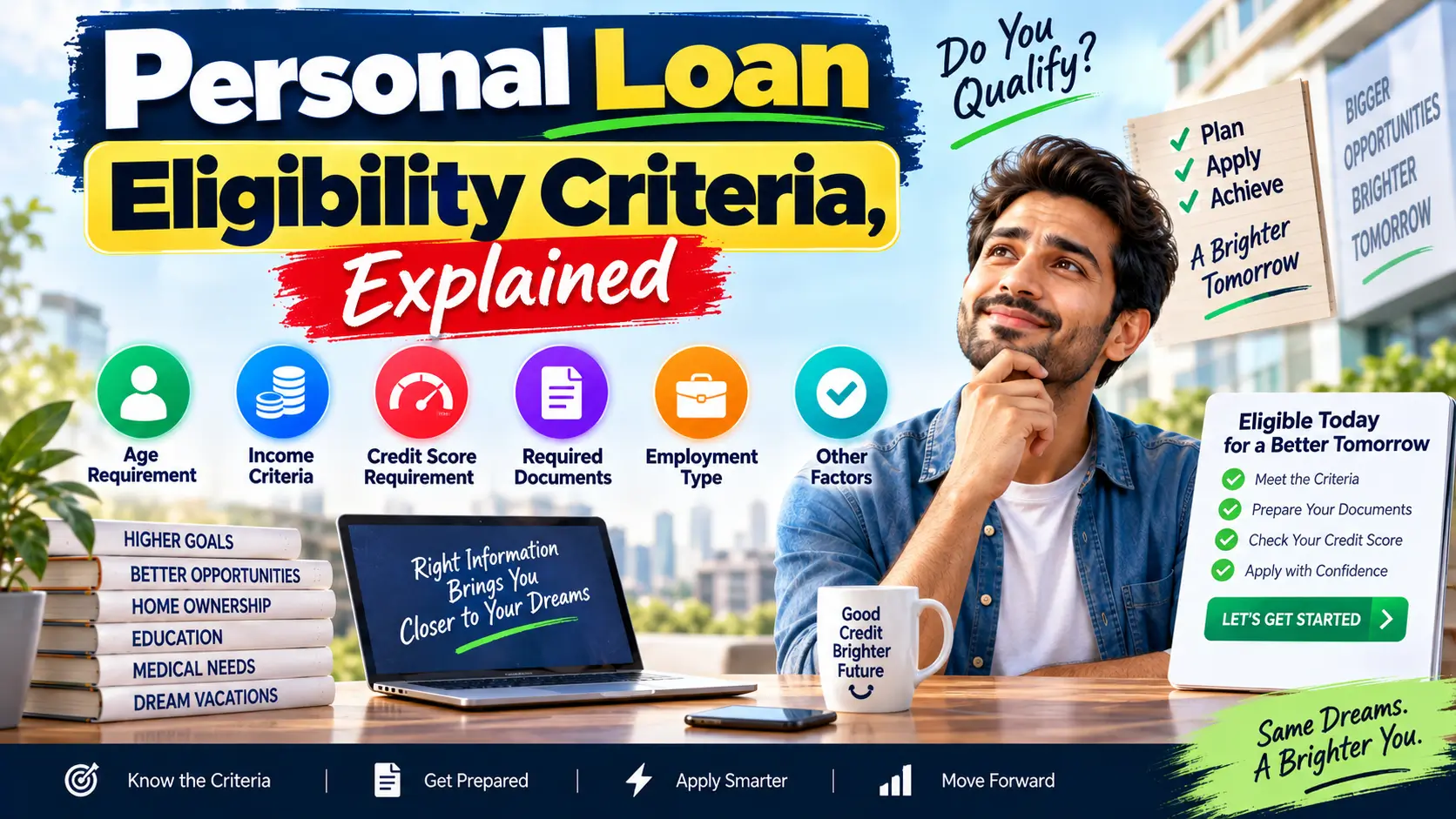
Credit Score
Most lenders will consider applicants with a credit score in the 580–600 range, but that tier typically comes with the highest rates and lowest approved amounts. A score of 670 or above generally opens up competitive rate tiers, and scores above 720 tend to unlock both the lowest rates and the highest approval ceilings, since lenders view that tier as the lowest default risk.
Debt-to-Income Ratio (DTI)
DTI is the percentage of your gross monthly income that already goes toward debt payments (credit cards, auto loans, student loans, existing personal loans — not utilities or groceries). It's calculated as:
DTI = Total monthly debt payments ÷ Gross monthly income × 100
As a general guide across lenders:
- Below 36% — strong position; likely to qualify for the highest amounts and best rates
- 36%–43% — still qualifiable, but approved amounts and rates get less favorable
- 43%–50% — approval becomes harder; expect a smaller loan and a higher rate if approved
- Above 50% — most traditional lenders will decline; a small number of specialty/bad-credit lenders may still work with you at much higher rates
DTI matters more than income alone. An applicant earning $50,000 a year with $2,500 a month in existing debt payments is often a weaker applicant than one earning $30,000 a year with $400 a month in debt — because the DTI math tells a different risk story.
Verifiable Income
Lenders need to confirm income, not just hear about it. Salaried applicants typically provide recent pay stubs or W-2s; self-employed applicants usually need tax returns or bank statements showing consistent deposits. As a rough ceiling, many lenders won't extend an unsecured personal loan beyond roughly half of your annual gross income, regardless of how clean your credit is — so a $40,000 income and a $30,000 loan request will draw more scrutiny than a $40,000 income and a $15,000 request, even with an identical credit profile.
Employment History
Lenders generally prefer to see at least one to two years of steady employment or self-employment income. Frequent job changes or large income gaps don't automatically disqualify you, but they usually mean more documentation requests and can affect the amount offered.
How Lenders Set Your Interest Rate
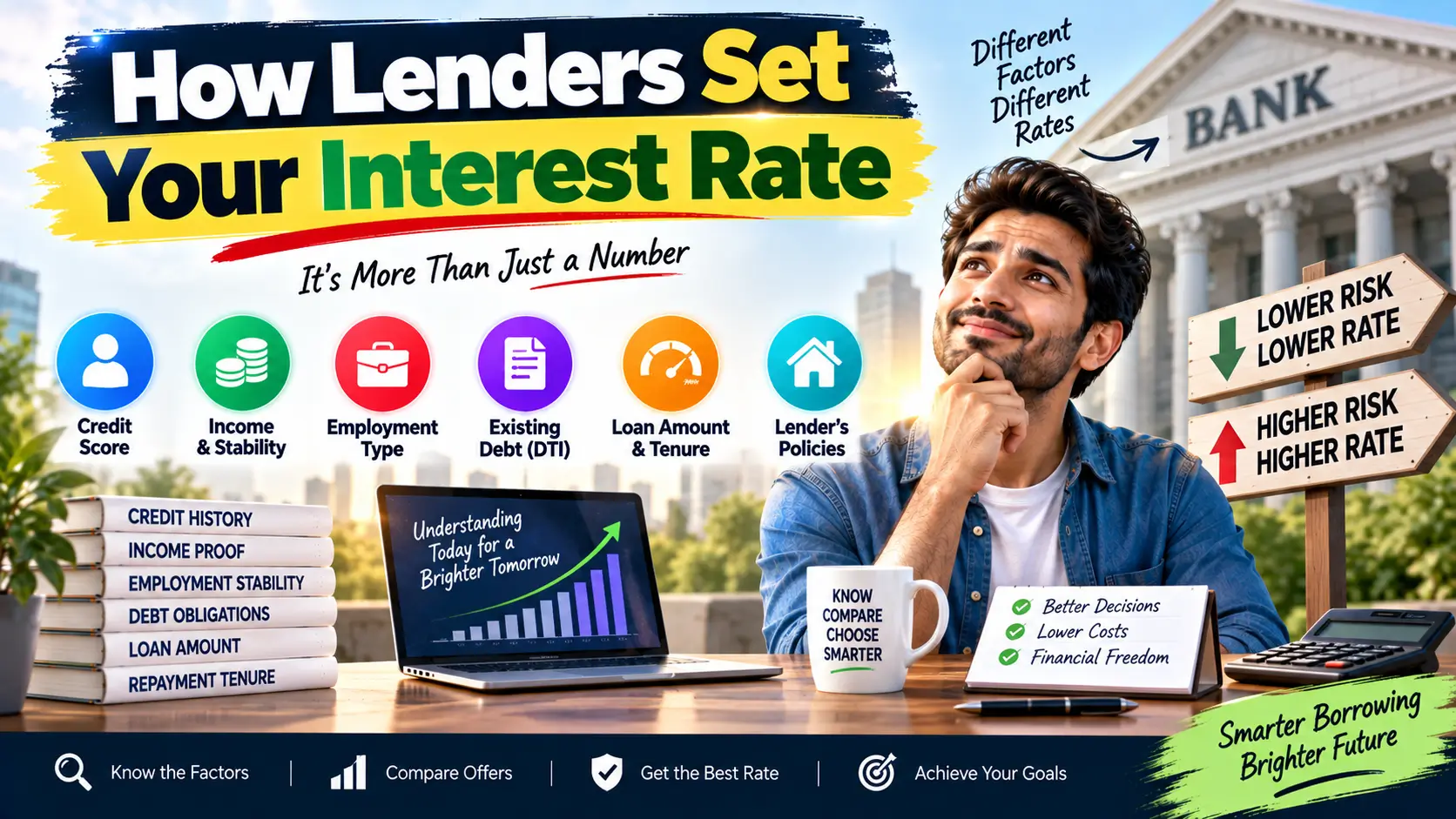
Personal loan rates are risk-based, meaning your specific rate depends on where you land across the factors above, not a single published number. As of current 2026 market data, personal loan APRs broadly span roughly 6% to 36%, with the middle of the market (borrowers with good-to-excellent credit) generally landing somewhere in the low-to-high teens depending on loan term — shorter terms tend to price lower than longer ones.
A few things that move your rate independent of credit score:
- Loan term — longer terms (5-year vs. 3-year) usually carry a higher rate
- Secured vs. unsecured — unsecured personal loans (the most common type) carry higher rates than loans backed by collateral
- Origination fees — some lenders charge 1%–10% of the loan amount upfront, which affects your APR even if the "rate" looks competitive
- Lender type — credit unions often price lower than online lenders for the same credit profile, but may have stricter membership or documentation requirements
(Rates shift weekly — check current published rates directly with lenders before relying on any specific number.)
What Is EMI and How Is It Calculated?
EMI stands for Equated Monthly Installment — a fixed payment that covers both principal and interest, paid on the same date every month until the loan is paid off. Even if your lender's paperwork calls it a "monthly payment" rather than "EMI," it's the same calculation.
The formula lenders use:
EMI = [P × r × (1 + r)ⁿ] ÷ [(1 + r)ⁿ − 1]
Where:
- P = principal (loan amount)
- r = monthly interest rate (annual rate ÷ 12, expressed as a decimal)
- n = loan tenure in months
Worked Example
Say you're approved for a $15,000 personal loan at 13.5% APR over 48 months.
- P = $15,000
- r = 13.5% ÷ 12 = 0.01125
- n = 48
Plugging into the formula gives an EMI of roughly $402/month, for a total repayment of about $19,300 — meaning roughly $4,300 in total interest over the life of the loan.
Two things worth noticing from this example:
- Term length changes total interest more than it changes your monthly comfort. Stretching the same loan to 60 months lowers the EMI to around $345/month, but total interest climbs to roughly $5,700 — about $1,400 more, just for a smaller monthly bite.
- A 1-point rate difference matters more on larger loans. On a $15,000 loan, moving from 13.5% to 12.5% saves a modest amount. On a $40,000 loan over the same term, that same 1-point difference saves several hundred dollars in total interest.
Run your own numbers with a few different term lengths before committing — the "greater" loan amount only helps you if the EMI still fits comfortably into your monthly budget.
How to Position Yourself for a Higher Approved Amount
If your goal is specifically a larger loan approval — not just any approval — these are the levers that actually move the needle:
- Pay down small recurring debts first. Eliminating a $150–$300/month obligation (even a small one) can meaningfully improve your DTI and shift your application into a stronger risk tier.
- Add verifiable secondary income. Side income, bonuses, or rental income can raise your income ceiling if you can document it consistently.
- Consider a co-applicant or cosigner. Adding someone with strong credit and income can significantly raise the approved amount, since the lender is now underwriting two incomes.
- Request an amount proportionate to your income. Applications for amounts far beyond a lender's informal income-based ceiling draw more scrutiny and get trimmed down more often — even with strong credit.
- Prequalify with multiple lenders first. Most reputable lenders offer prequalification with a soft credit check that doesn't affect your score, letting you compare realistic offer amounts before committing to a hard inquiry.
- Check your credit report for errors before applying. Incorrect late payments or reporting errors can quietly suppress your score — and your approved amount — for no real reason.
Step-by-Step: How to Apply for a Personal Loan
- Check your credit score and report. Know your starting position and dispute any inaccuracies first.
- Calculate your DTI. Use the formula above so you know roughly what range of loan amount is realistic before you apply.
- Prequalify with 3–4 lenders. Compare estimated rates and amounts using soft-check prequalification tools.
- Gather documentation. Typically: government ID, proof of address, recent pay stubs or tax returns, and bank statements.
- Compare full loan terms, not just the rate. Look at origination fees, prepayment penalties (or lack of one), and the APR — not the advertised interest rate alone.
- Submit the formal application. This triggers a hard credit inquiry, so only do this with the lender(s) you're seriously considering.
- Review the loan agreement before signing. Confirm the EMI, total repayment amount, and fee structure match what you were quoted.
- Set up autopay if offered. Many lenders provide a small rate discount for automatic payments, and it protects your credit from missed-payment risk.
Common Mistakes That Shrink Your Approved Amount
- Applying for an amount far above your income-based ceiling "just to see"
- Applying with multiple lenders using hard inquiries instead of prequalifying first
- Ignoring existing small debts that are quietly inflating your DTI
- Choosing the lowest EMI without checking total interest paid over the full term
- Not documenting side income because it "seems like too much paperwork"
Frequently Asked Questions (FAQs)
Is a longer loan term always better for a bigger loan amount?
Not necessarily. A longer term can lower your EMI and make a larger loan amount look more affordable on paper, but it increases total interest paid. Lenders may approve a larger amount over a longer term specifically because the EMI fits your DTI — but you should compare total cost, not just monthly payment, before choosing term length.
Does prequalifying hurt my credit score?
No. Prequalification typically uses a soft credit inquiry, which doesn't affect your score. Only the formal application triggers a hard inquiry.
Can I get a bigger loan by adding a cosigner?
Often, yes. A cosigner with strong credit and income reduces the lender's risk and can meaningfully raise the approved amount, but the cosigner becomes equally responsible for repayment if you miss payments.
What DTI do I need for the largest loan amounts?
Most lenders reserve their highest approval amounts and best rates for applicants with a DTI below roughly 36%. Between 36% and 43% you can typically still qualify, just for a smaller amount or at a higher rate.
Is EMI the same as a "monthly payment"?
Yes — EMI and "monthly payment" refer to the same fixed, recurring amount that covers principal and interest over the loan term. EMI is the more common term outside the U.S., but the underlying math and formula are identical.
Bottom Line
Qualifying for a larger personal loan comes down to three levers you can actually influence before you apply: your credit score, your DTI, and how well you can document your income. Fix those first, prequalify with a few lenders to compare realistic offers, and run the EMI math on more than one term length before you sign anything. The largest available loan isn't always the right one — the right one is the largest amount whose EMI you can comfortably absorb without stretching your monthly budget.
For additional consumer protections and complaint resources around personal loans, the Consumer Financial Protection Bureau is a useful independent reference.
This article is for general educational purposes and isn't personalized financial advice. Loan terms, rates, and eligibility criteria vary by lender and change frequently — confirm current terms directly with any lender before applying.