Car Accident Loan: How to Get Money After a Crash Without Waiting for Your Settlement

If you've been searching for a car accident loan, you're probably staring down a stack of medical bills, missed paychecks, and a lawsuit or insurance claim that could take a year or longer to resolve. A quick Google search will turn up dozens of companies promising cash in 24 hours with "no credit check" and "nothing to repay if you lose." What almost none of them will tell you upfront is what the money actually costs.
This guide breaks down what a car accident loan really is, what it costs in plain numbers, which states restrict or regulate it as of 2026, and — most importantly — which cheaper options you should rule out first. We're not a funding company, so we don't have a stake in whether you sign a contract. Our only goal is to make sure you understand the real math before you do.
Quick disclosure: This article is educational, not legal or financial advice. Laws on this product vary by state and are changing quickly in 2026 — talk to your attorney before signing any funding agreement.
What Is a "Car Accident Loan," Really?

Despite the name, a car accident loan isn't a loan in the traditional sense. It's more accurately called pre-settlement funding or a lawsuit cash advance: a company gives you money now in exchange for a cut of your eventual car accident settlement or verdict.
The industry leans on the word "loan" because that's what people type into Google. But the legal and financial mechanics are different from a bank loan in three important ways:
- It's non-recourse. If you lose your case or settle for less than expected, you typically don't have to repay the advance out of your own pocket — the funding company absorbs the loss.
- There's no credit check and no monthly payment. Approval is based on the strength of your case (liability, documented injuries, available insurance coverage), not your credit score or income.
- It isn't regulated like a consumer loan in most states. Traditional loans are subject to state usury caps, Truth in Lending Act disclosures, and other consumer protections. Because pre-settlement funding is structured as a purchase of a stake in your future settlement rather than a loan, it has historically sat outside most of that framework — though that's actively changing (more on this below).
That last point is the one worth sitting with. The non-recourse structure is genuinely a real benefit. But it's also the industry's justification for charging far more than a conventional loan would.
How the Process Actually Works
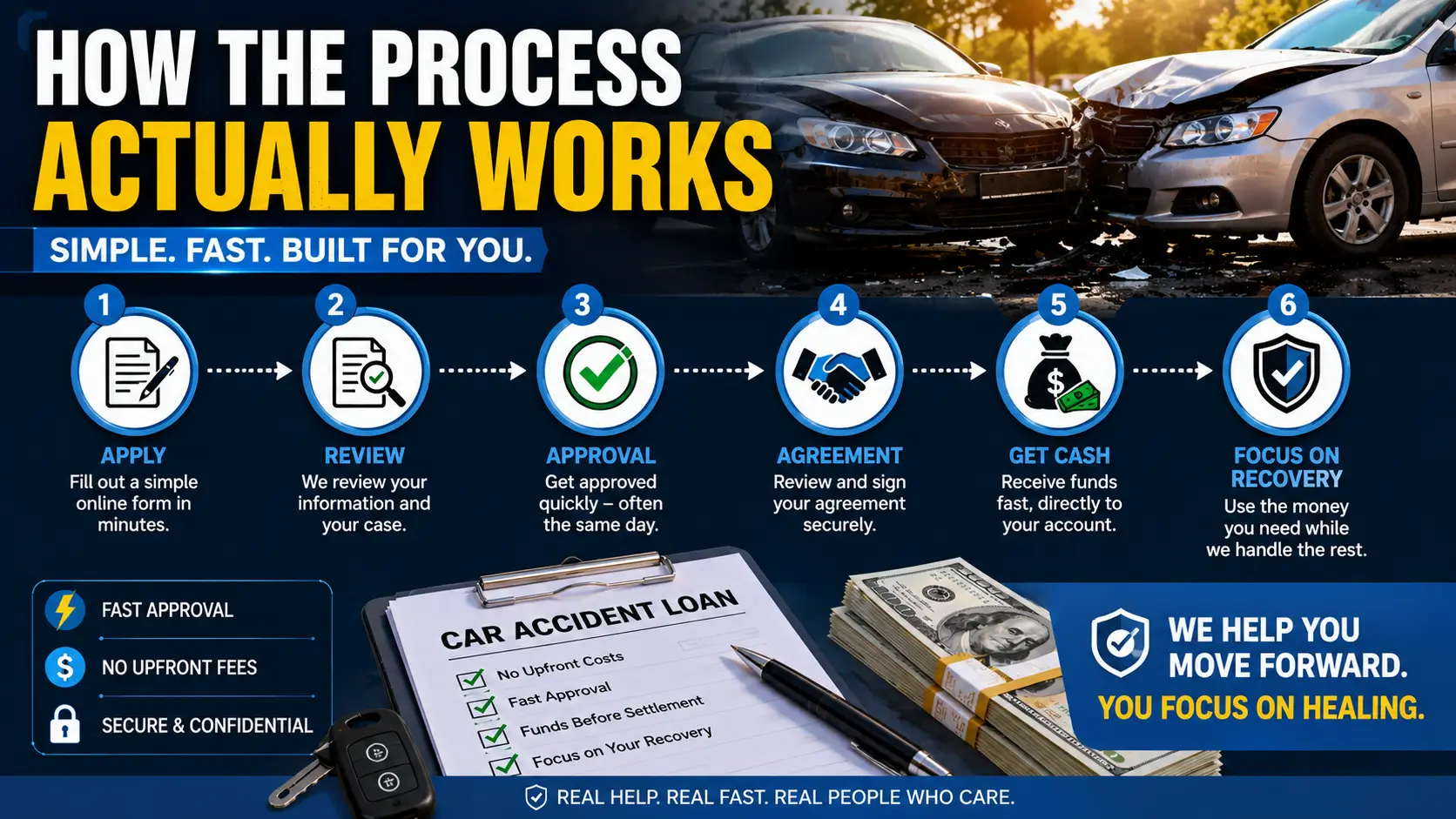
The application process is intentionally fast and simple — that's the product's main selling point. It typically looks like this:
- You (or your attorney) apply. You'll provide basic details about the accident, your injuries, and your attorney's contact information. Most companies require that you already have a personal injury attorney representing you.
- The funding company contacts your attorney. They review liability, documented damages, and the at-fault driver's available insurance coverage to estimate how much your case is likely worth.
- You get an offer. If your case qualifies, you'll receive a proposed advance amount — usually a small fraction of the case's estimated value, often in the 10%-15% range — along with the fee or interest structure.
- You and your attorney sign the funding agreement. The money is typically wired within 24-48 hours of signing.
- When your case settles, the advance, plus fees, is paid out of the settlement proceeds by your attorney before the remaining funds come to you.
Notice what's missing from that list: at no point does the funding company evaluate your ability to repay in the traditional sense, because repayment doesn't come from you — it comes from your settlement. That's exactly why the pricing looks so different from a bank loan.
What It Actually Costs: The Math the Ads Don't Show You
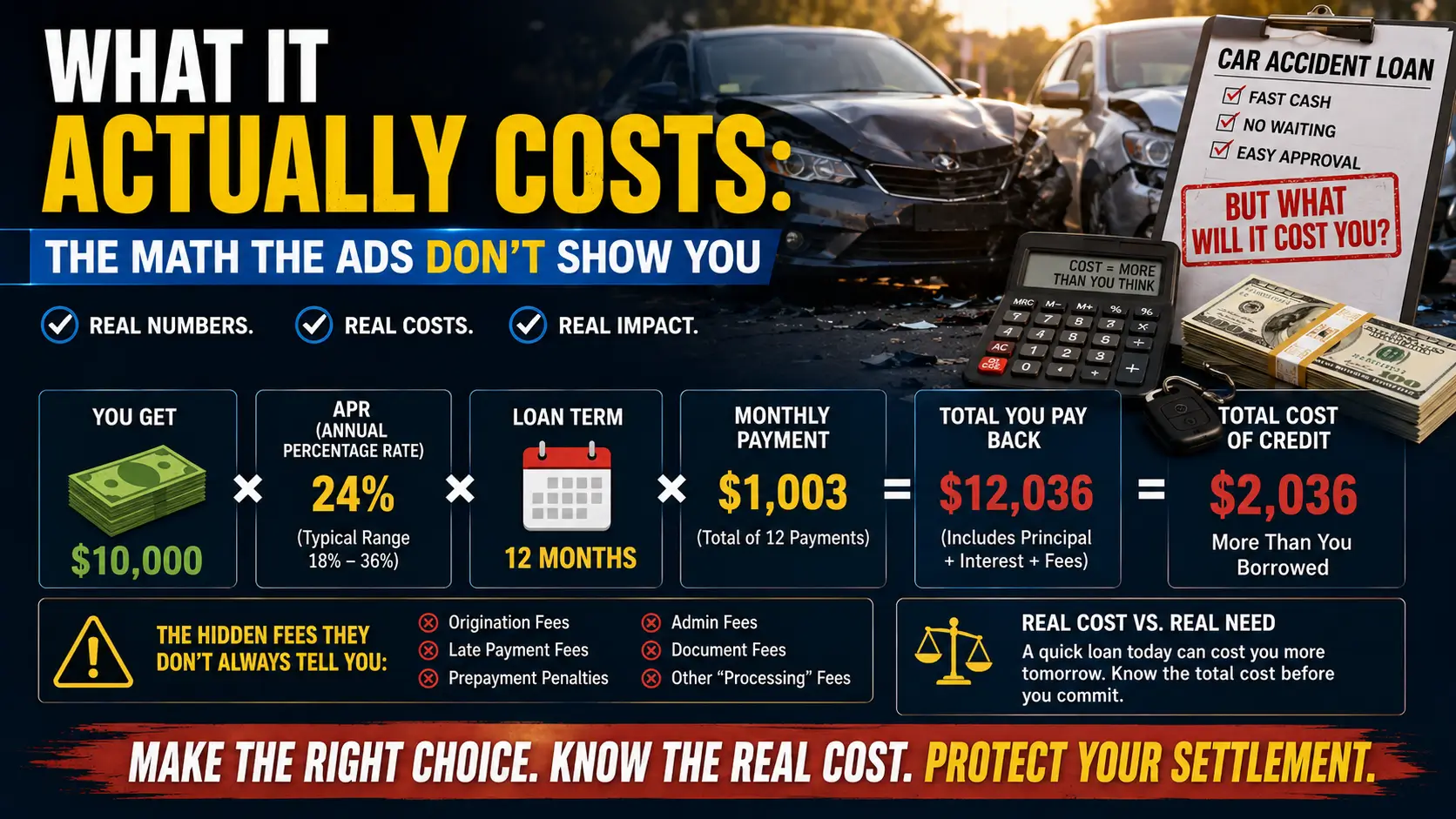
This is the part most car accident loan marketing pages either bury or skip entirely. Here's what the cost structure actually looks like.
Reported rates vary enormously — and the range is the point. Some of the more transparent funders in the industry advertise simple (non-compounding) rates in the neighborhood of 15%-20% every six months, while others report annualized rates in the 27%-41% range. On the higher end, a widely cited 2022 academic analysis from Duke Law's FinReg Blog found that typical consumer litigation funding contracts carried effective APRs exceeding 150%. Multiple sources describe rates as high as 100% annually even among established providers, particularly on advances that sit unpaid for two or three years while a case works through the courts.
Why the spread is so wide:
- Simple vs. compound interest. A rate quoted as "2.5%-3% a month" sounds modest, but if it compounds monthly rather than applying only to the original advance, the total owed can balloon dramatically the longer a case takes to resolve.
- Case duration risk is priced in. Roughly 95%-96% of personal injury cases settle before trial, but "settle" can still mean one to three years of waiting — and the funder is pricing the risk that your case is among the small share that produces a partial or full loss for them.
- No universal rate cap. Unlike payday loans or title loans, which most states now cap by law, pre-settlement funding historically hasn't been treated as a "loan" for usury-cap purposes in most states — so there's often no ceiling on what a company can charge.
A simplified example: Say you take a $10,000 advance at a 3% monthly compounding rate, and your case takes 20 months to settle. At that rate, the amount owed at settlement can grow to roughly double the original advance — meaning $10,000 in cash today could cost you $10,000 or more in additional fees out of your final settlement check. Some companies cap the total repayment (often at 2x the advance) specifically to prevent this from spiraling further; others don't. This is exactly why the exact terms of your contract matter more than any advertised "starting rate."
The bottom line: treat the advertised rate the same way you'd treat a payday loan's advertised fee — as a starting point for questions, not the final number. Ask specifically whether the rate is simple or compound, whether there's a cap on total repayment, and get the dollar total in writing for a range of possible settlement dates (12, 18, 24 months out).
Is This Legal Everywhere? A 2026 Regulatory Snapshot
Pre-settlement funding has operated in a legal gray zone for years, but that's shifting fast. A few developments worth knowing about as of mid-2026:
- New York enacted the Consumer Litigation Funding Act, signed December 19, 2025 and effective June 17, 2026. It caps what a funding company can take from a settlement at 25% of the gross recovery, requires plain-language contracts, gives consumers a 10-business-day right to cancel, and requires funders to register with the state's Department of Financial Services.
- North Carolina went further, enacting what's reported to be the first outright state ban on third-party litigation financing in civil cases, effective June 22, 2026.
- Several other states regulate the industry through disclosure requirements or fee structures rather than outright bans, and more state legislation is reportedly in motion.
- Some industry sources claim the product is unavailable or restricted in roughly a third of states — we haven't been able to independently verify an exact, current count from a primary legal source, so treat any specific number you see (including that one) with some skepticism until you confirm your own state's status directly.
What this means for you: the rules where you live may be completely different from the rules in the state where the funding company is based. Before signing anything, ask directly: "Is this contract governed by the laws of my state, and does your company comply with [your state]'s consumer litigation funding law, if one exists?" Your attorney can verify this in a few minutes — and should, before you sign.
Cheaper Ways to Get Cash After a Crash (Ranked by Cost)
A car accident loan should generally be a last resort, not a first move, because nearly every other option costs less. Here's a realistic ranking, roughly cheapest to most expensive.
1. MedPay or Personal Injury Protection (PIP) — usually the cheapest
If you have Medical Payments Coverage (MedPay) or PIP on your own auto policy, this is often the fastest and least complicated source of cash. It pays your accident-related medical bills regardless of fault, with no repayment required later — you already paid for this coverage as part of your premium. Check your policy's declarations page or call your insurer to see if you have it and what the limit is.
2. Your own health insurance
Your health insurer will typically pay providers directly, though they may later place a subrogation claim against your eventual settlement to recoup what they paid. Still, this is almost always far cheaper than a cash advance, since you're paying back what was spent — not a fee on top of it.
3. A Letter of Protection (LOP) or medical lien
If you're uninsured or have exhausted other coverage, your attorney can often negotiate a Letter of Protection: a written agreement where a medical provider treats you now and defers payment until your case resolves. A medical lien works similarly but is a formal legal claim against your settlement. Neither typically carries an "interest rate" the way a cash advance does, though provider bills may be higher than an insurance-negotiated rate — ask about this upfront.
4. State crime victim compensation funds
If your accident involved a hit-and-run, DUI, or another driver's criminal conduct, many states have a victim compensation fund that can help cover medical bills and lost wages, independent of your civil case. Ask your attorney or your state's Attorney General's office whether you qualify.
5. A 0% intro APR credit card or a credit union personal loan
If your credit is in reasonable shape, a 0%-intro-APR card or a small personal loan from a credit union will almost always cost less than a pre-settlement advance — sometimes by tens of thousands of dollars over a long case. The tradeoff is you're personally on the hook for repayment regardless of how your case turns out, which is the real reason people turn to non-recourse funding instead.
6. A short-term advance from family, or a hardship program with your employer or utility providers
Not always available, but worth asking about before signing a funding contract — many utility companies, landlords, and even some employers have hardship or deferred-payment programs that cost nothing.
7. Pre-settlement funding (car accident loan) — the most expensive, but sometimes the only option left
If you've exhausted the above and still can't cover essentials, a car accident loan exists precisely for that gap. It's genuinely useful for people with no other access to credit and a strong, well-documented case. Just go in with clear eyes about the cost.
Cost comparison at a glance
| Option | Typical cost | Repayment required if you lose your case? |
|---|---|---|
| MedPay / PIP | Already paid for (no added cost) | No — it's your own coverage |
| Health insurance | Cost of premiums + possible subrogation | No added interest |
| Letter of protection / medical lien | Provider's billed rate, no separate "interest" | Lien may still apply depending on outcome — ask your attorney |
| 0% intro APR credit card | 0% for promo period, then card's standard APR | Yes — you owe this regardless of your case outcome |
| Credit union personal loan | Roughly 8%-18% APR (varies by credit profile) | Yes — you owe this regardless of your case outcome |
| Car accident loan (pre-settlement funding) | Roughly 27%-150%+ effective APR depending on company and case length | No — non-recourse if properly documented |
Figures are illustrative ranges based on industry-reported data as of 2026 and will vary by lender, state, and individual case — confirm current numbers before publishing or relying on this table for a specific decision.
Is a Car Accident Loan Ever the Right Call?
[FIRST-PERSON PLACEHOLDER — replace before publishing: Azahar to add a genuine observation or case example here, e.g., a specific scenario reviewed, a pattern seen across contracts, or a conversation with a reader/client that illustrates when this product made sense versus when it didn't.]
In general, pre-settlement funding tends to make the most sense when all of the following are true:
- You've already exhausted MedPay, health insurance, LOPs, and low-cost credit
- Your case has clear liability and well-documented injuries (which usually means a lower, more favorable rate)
- You're using the money for genuine essentials — rent, food, medical care — rather than discretionary spending
- Your attorney has reviewed the specific contract, not just the company's marketing page
It tends to make the least sense when your case is disputed, weak, or likely to take several years, since that's exactly when compounding fees do the most damage to your final payout.
Red Flags: How to Avoid a Predatory Provider
Not all pre-settlement funding companies operate the same way. Watch for these warning signs:
- "Guaranteed approval" before any case review. Legitimate funders always evaluate your case with your attorney first.
- Requests for any upfront payment or fee. You should never pay to apply or to receive funding.
- Reluctance to state clearly whether the rate is simple or compound. If a representative can't answer this in plain language, that's a red flag on its own.
- No cap on total repayment. Ask directly whether there's a maximum you'll ever owe, regardless of how long the case takes.
- Pressure to sign before your attorney has reviewed the contract, or a funder that tries to contact you directly instead of going through your attorney.
- A company that's rebranded recently or has limited public track record. A quick search for the company name plus "complaint" or "lawsuit" is worth five minutes of your time.
Questions to Ask Before You Sign
Bring this list to your attorney before agreeing to any car accident loan:
- Is this a simple or compound rate, and what's the exact dollar total I'd owe at 12, 18, and 24 months?
- Is there a cap on the maximum I'll ever have to repay?
- Does this company comply with my state's consumer litigation funding law, if one exists?
- What happens if my case settles for less than expected — does the funding company still take its full amount first?
- Is there a prepayment penalty if my case settles early and I want to pay this off sooner?
- What's the cancellation or rescission period, and is it in writing?
Frequently Asked Questions (FAQs)
Is a car accident loan a real loan?
Not technically. It's a non-recourse cash advance against your expected settlement, not a traditional loan with a credit check and monthly payments. Industry and consumers commonly call it a "loan" because that's the familiar term, but the legal structure — and the lack of standard loan protections in many states — is different.
How much does a car accident loan actually cost?
Costs vary widely by company, state, and how long your case takes to resolve. Reported effective rates range from roughly 27% to well over 100% annualized, depending on whether the rate is simple or compounding and how long the advance is outstanding.
Do I need a lawyer to get a car accident loan?
Almost always, yes. Funding companies typically require an attorney to confirm case details and to handle repayment out of the eventual settlement.
Will taking a car accident loan hurt my credit score?
No — because there's no credit check and no personal repayment obligation, most pre-settlement funding doesn't appear on your credit report or affect your score.
What happens if I lose my case?
With a properly structured non-recourse agreement, you typically don't owe anything back. Confirm this explicitly in writing before signing, since the exact terms vary by contract.
Is a car accident loan legal in my state?
It depends. As of mid-2026, most states allow it with varying degrees of regulation, New York has newly capped fees and added consumer protections, and North Carolina has banned the product outright. Confirm your state's current rules with your attorney before applying.
This article is for informational purposes only and isn't legal, financial, or medical advice. Pre-settlement funding terms, costs, and legality vary significantly by state and by company — always have your attorney review any funding contract before you sign.