JPMorgan Chase Credit Card Class Action 2026: Latest Updates & Settlement News
If you're a Chase credit cardholder, 2026 is a year to pay attention. JPMorgan Chase — the largest bank in the United States — is currently defending multiple active class action lawsuits covering everything from fraudulent membership charges and a decades-long interest rate conspiracy to a high-profile $5 billion debanking suit filed by President Donald Trump himself.
This guide breaks down every active case, what it means for cardholders, whether you may qualify for compensation, and what steps you should take right now.
Quick answer: As of May 2026, no major new settlements have been finalized in the current wave of lawsuits. However, a separate credit card membership fee case is reportedly in active settlement discussions, with claimed payouts for qualifying cardholders who held Chase cards between 2019 and 2024. Always verify claim details at official court-linked settlement portals before submitting personal information.
Overview: How Many Lawsuits Is Chase Facing in 2026?
JPMorgan Chase faces at least seven separate class action lawsuits in early 2026, spanning allegations of fraudulent credit card membership charges, a 30-year conspiracy to fix interest rates with six other major banks, data breach failures, retirement plan violations, and First Republic Bank transition problems.
Here's a quick snapshot of the active cases most relevant to credit cardholders:
| Case | Filed | Court | Status (May 2026) |
|---|---|---|---|
| Sacchi v. JPMorgan Chase (membership fraud) | Sept 2025 | SDNY | Class certification phase |
| Normandin v. JPMorgan Chase (interest rate fixing) | Oct 2025 | D. Connecticut | Early discovery |
| Trump v. JPMorgan Chase (debanking) | Jan 2026 | Miami-Dade, FL | Active, Chase contesting |
| Carmichael v. JPMorgan Chase (ERISA/tobacco) | Jan 2026 | SDNY | Early stage |
None of these cases have reached settlement as of early 2026. Most are in early stages with defendants filing motions to dismiss or answering complaints.
Case #1: Sacchi v. JPMorgan Chase — Fraudulent Credit Card Membership Charges
This is the case that matters most to everyday Chase credit cardholders.
What's Being Alleged
Plaintiff John Sacchi filed a class action complaint against JPMorgan Chase Bank and JPMorgan Chase & Co. on September 12, 2025, in New York federal court, alleging violations of state and federal consumer laws. According to the lawsuit, JPMorgan Chase fraudulently solicited consumers to purchase credit card memberships by promising automatic credits for certain purchases but then failed to provide those credits.
The plaintiff claims he was induced to pay a $750 annual membership fee based on promises of "automatic credits" for restaurant and music service purchases. Despite making qualifying purchases, Sacchi alleges Chase failed to apply the promised credits, forcing customers to pay the full amount or incur interest and penalties. The lawsuit claims this isn't a glitch but a deliberate strategy to collect high annual fees while denying the benefits that justify them.
The case is formally titled Sacchi v. JPMorgan Chase Bank N.A., et al., Case No. 1:25-cv-07632, in the U.S. District Court for the Southern District of New York.
Who Could Be Covered
Sacchi is looking to represent anyone who made one or more charges on a JPMorgan Chase-issued credit card in the United States for products and/or services, which charge(s) was/were required to be automatically credited pursuant to the company's promises but were not.
In plain terms: if you held a premium Chase card — think Sapphire Reserve, Sapphire Preferred, or a co-branded travel card — and noticed that promised statement credits for dining, streaming, travel, or other categories simply never appeared, you could potentially be a class member.
Current Status
As of early 2026, the case is currently in the class certification phase. If certified, it could cover anyone who paid for a Chase credit card membership and did not receive promised automatic statement credits in 2025 or 2026.
Chase has not publicly responded to these allegations and no settlement has been announced as of early 2026.
A Related Settlement Claim (Proceed With Caution)
Some third-party legal information sites have described a separate but related credit card membership fee settlement — distinct from the Sacchi lawsuit — that reportedly involves annual fees charged between 2019 and 2024. Most Chase cardholders who paid fees between 2019 and 2024 may qualify under this framework. You do not need to currently hold the card — former cardholders who closed their accounts are still eligible.
Important: InvestoBuzz cannot independently verify the current settlement status, deadlines, or payout amounts for this case. Always confirm details through official court-linked settlement portals or resources like TopClassActions.com or ClassAction.org before submitting any personal information.
Case #2: Normandin v. JPMorgan Chase — 30-Year Interest Rate Fixing Conspiracy
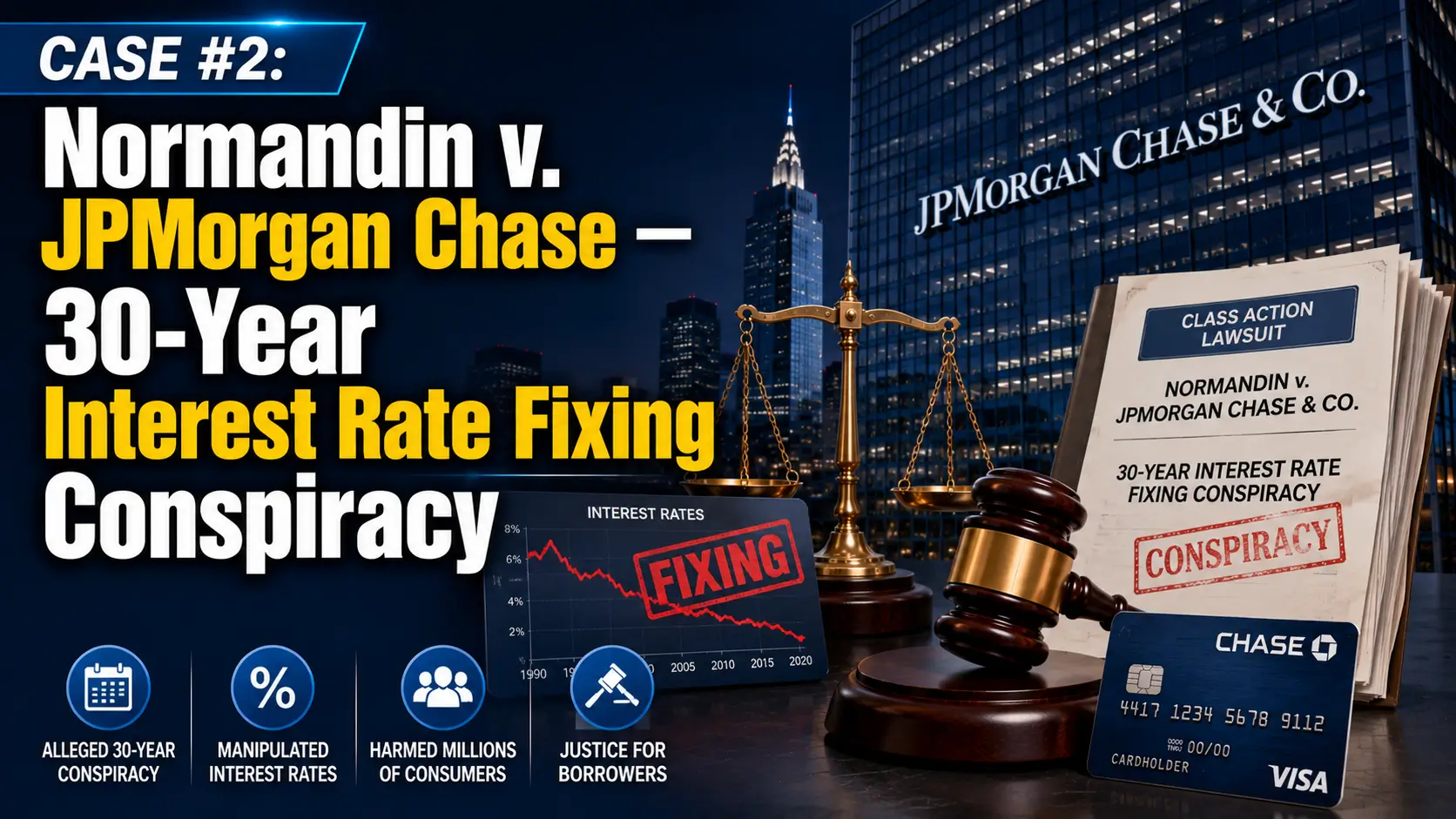
This case goes far beyond credit cards — it targets the very foundation of how banks set borrowing rates for American consumers.
What's Being Alleged
An antitrust lawsuit filed on October 27, 2025, in Connecticut federal court (Normandin v. JPMorgan Chase, Case No. 3:25-cv-01749) accuses Chase and six other banks — Bank of America, Wells Fargo, Citibank, U.S. Bank, PNC Bank, and Truist Bank — of colluding to fix interest rates on consumer and small-business loans for over 30 years.
Plaintiffs claim the banks' collusion was facilitated by the Federal Reserve's 1994 decision to publish explicit targets for the federal funds rate, allowing banks to peg their prime rates to publicly available benchmarks. The lawsuit argues this conspiracy persisted despite regulatory reforms and digital transformation in banking. The complaint seeks treble damages — triple the actual damages — for alleged overcharges, as permitted under federal antitrust law.
What It Means for Cardholders
If proven, this conspiracy would mean that credit card APRs, personal loan rates, and small business loan rates were artificially inflated for decades — meaning consumers overpaid on interest charges that should have been lower. Treble damages could make potential payouts significant for qualifying plaintiffs, though cases of this scale typically take years to resolve.
Current Status
The case is in early discovery as of mid-2026, with defendants expected to file motions to dismiss. No settlement timeline exists yet.
Case #3: Trump's $5 Billion "Debanking" Lawsuit
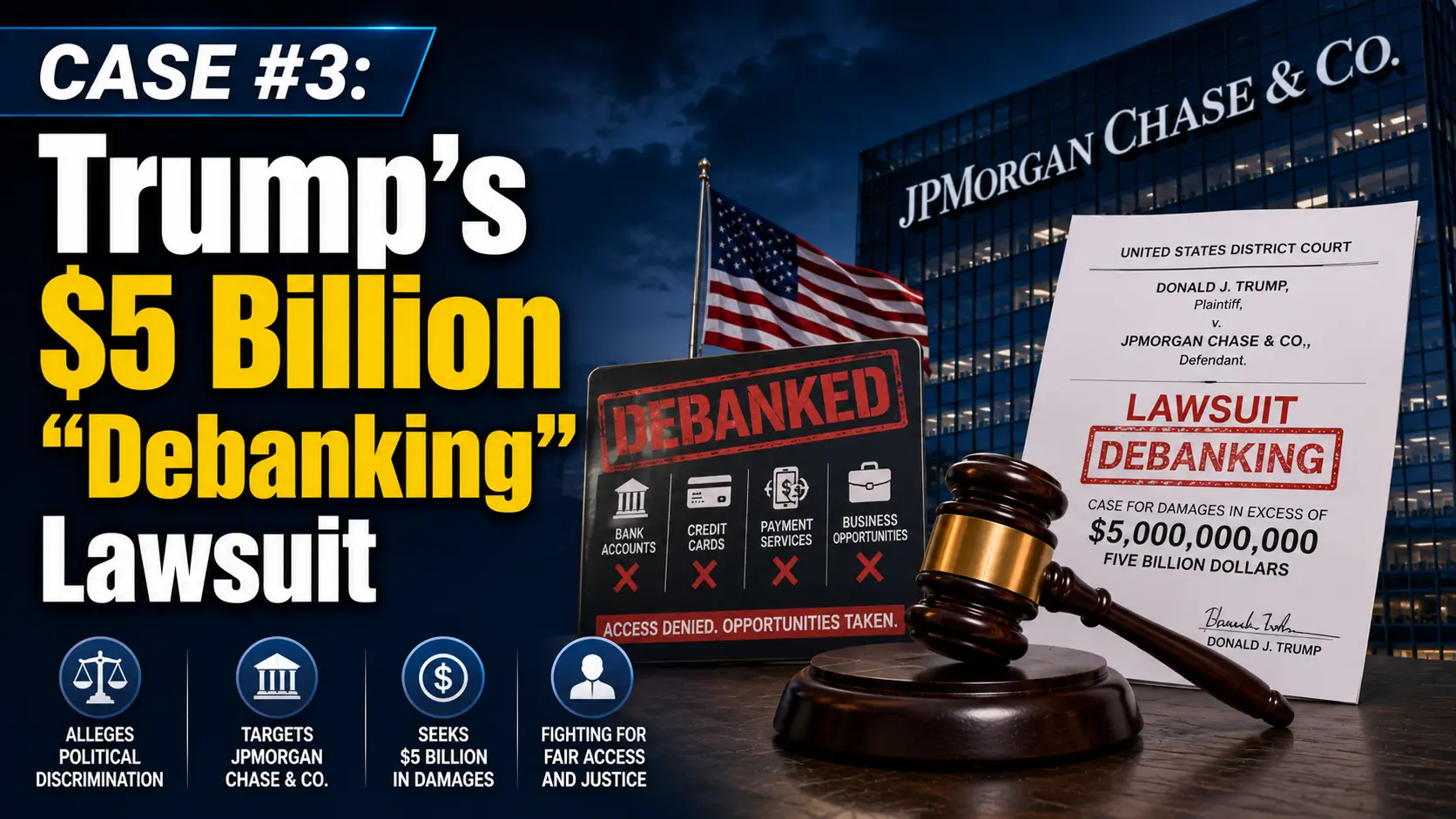
While not a traditional consumer class action, this high-profile case is relevant context for anyone concerned about how Chase handles account closures.
What Happened
President Donald Trump sued banking giant JPMorgan Chase and its CEO Jamie Dimon for $5 billion on January 22, 2026, over allegations that JPMorgan stopped providing banking services to him and his businesses for political reasons after he left office in January 2021. The lawsuit, filed in Miami-Dade County court in Florida, alleges that JPMorgan abruptly closed multiple accounts in February 2021 with just 60 days' notice and no explanation.
Trump's lawyers allege that JPMorgan placed the president and his companies on a reputational "blacklist" that both JPMorgan and other banks use to keep clients from opening accounts with them in the future.
Chase's Response
JPMorgan Chase said it believes the suit has no merit. "We respect the President's right to sue us and our right to defend ourselves — that's what courts are for," a spokesperson said.
Why Regular Cardholders Should Care
This lawsuit puts a national spotlight on how banks can close accounts under "reputational risk" policies — and without clearly explaining their reasons. If you've ever had a Chase account closed unexpectedly, this case could eventually produce legal precedents that affect how banks must communicate closures to all customers.
Case #4: Carmichael v. JPMorgan Chase — ERISA Tobacco Surcharge Violations

The most recent lawsuit, filed in January 2026, is Carmichael v. JPMorgan Chase & Co. (Case No. 1:26-cv-00305). Plaintiff Robyn Carmichael claims the bank unfairly targeted employees based on health status by charging punitive premiums for tobacco users, allegedly violating ERISA — the federal law governing employee benefit plans.
This case does not directly affect credit cardholders but is relevant to Chase employees and adds to the bank's growing legal exposure in 2026.
Older Settled Cases: What Chase Has Already Paid
Chase has a documented history of settling class action cases. Here's what they've previously agreed to:
2012–2013: $100 Million Minimum Payment Settlement
JPMorgan Chase agreed to pay $100 million to settle litigation by credit card customers who accused the bank of improperly boosting their minimum payments. The case stemmed from Chase's decision in late 2008 and 2009 to raise minimum monthly payments for thousands of cardholders from 2% of account balances to 5%. Cardholders claimed that JPMorgan had induced them to transfer balances from other lenders to Chase accounts with promises of fixed, low interest rates until balances were paid off.
2013: $309 Million CFPB Refund for Add-On Products
In 2013, Chase agreed to a $309 million refund to affected customers following CFPB investigation into its credit card add-on practices. Customers had reported being charged for services like "Credit Protection Plus" and "Payment Protector" that they say they never agreed to.
Payment Card Interchange Fee Litigation
One major Chase settlement involved the Payment Card Interchange Fee Litigation. This case accused Chase and other banks of conspiring with Visa and Mastercard to fix transaction fees. The settlement fund exceeded $5.5 billion across all defendants, making it the largest credit card settlement in U.S. history — primarily for merchants, though some consumer classes also received compensation.
The pattern is clear: Chase has repeatedly faced accountability through the courts and regulatory agencies, and when evidence has been strong, they've settled — sometimes for hundreds of millions of dollars.
Am I Eligible? How to Know If You Qualify
Eligibility varies by case, but here's a general framework for the current 2026 lawsuits:
For the Sacchi membership credits case:
- You held a JPMorgan Chase-issued credit card (especially premium cards with annual fees)
- Chase promised automatic statement credits for specific purchase categories
- Those credits were not applied to your account as promised
For the interest rate fixing case (Normandin):
- You held a Chase credit card, personal loan, or small business loan during the alleged conspiracy period
- You paid interest on those balances
For older settled cases: To qualify for a Chase settlement, you typically need to have held a Chase credit card during the affected time frame. Some settlements require you to have paid certain fees or interest charges.
General rule of thumb: If you were a Chase cardholder during the relevant period and experienced the specific issue alleged, you're likely at least a potential class member. You don't need to hire your own lawyer — class counsel represents all class members.
How to File a Claim (Step-by-Step)
For any active settlement, here's the standard process:
- Check for an official notice. Class members typically receive direct mail and email notices from the settlement administrator. If you did not receive a notice but believe you qualify, you can still file a claim through the settlement website.
- Find the official settlement portal. Search the case name plus "settlement" at ClassAction.org or TopClassActions.com. Bookmark the court-linked URL only — never trust third-party "claim filing" sites.
- Gather your documentation. Old billing statements, account numbers, and records of annual fees paid will strengthen your claim and potentially increase your payout. Basic claims can be filed with self-attestation alone, though payouts will be lower.
- Submit before the deadline. For any active settlement, missing the claim deadline means forfeiting your share. Calendar it immediately.
- Wait for court approval. Class action settlements require final court approval before checks go out. Delays of two to three months are not uncommon in class actions.
How to Spot Class Action Scams
The flood of Chase lawsuit coverage in 2026 has unfortunately attracted scammers. Here's how to protect yourself:
Real settlements never ask you to pay money to receive money. That is the clearest scam indicator. If you receive a settlement notice you are unsure about, search the case name plus "class action" online — legitimate cases have extensive documentation.
Red flags to watch for:
- A website asking for an upfront "processing fee" or "legal fee" before you receive your payout
- Requests for your full Social Security number before a settlement is even finalized
- Pressure to act "immediately" before a vague deadline
- Emails from unofficial domains (legitimate notices come from court-appointed settlement administrators)
Class action attorneys already represent you as a class member — you do not need to pay anyone to join.
When in doubt, go directly to PACER (Public Access to Court Electronic Records at pacer.gov) to look up the actual case and find official contact information.
Frequently Asked Questions (FAQs)
Do I need to do anything right now if I'm a Chase cardholder?
For the current active lawsuits (Sacchi, Normandin), no action is required yet. These cases are still in pre-settlement stages. Monitor TopClassActions.com for updates and sign up for email alerts.
Will filing a claim affect my Chase account?
Participating in a settlement will not affect your current Chase accounts or credit standing. Chase cannot close your accounts or change your terms because you filed a claim.
Can I opt out of a class action?
Yes. Class members always have the right to opt out of a settlement and pursue individual claims, though this is rarely advisable unless your individual damages are exceptionally large. The opt-out deadline will be specified in your settlement notice.
What if I closed my Chase account years ago?
Former cardholders who closed their accounts are still eligible, as long as the account was open during the class period.
How do I know if a settlement notice I received in the mail is real?
Search the exact case name on Google along with "class action." Real settlements will have coverage on established legal news sites and official court documentation you can look up on PACER.
Has Chase admitted wrongdoing in any of these cases?
JPMorgan Chase has generally denied wrongdoing in most of these cases. The bank's legal teams have argued that customers agreed to the membership terms, that disclosures were clearly provided, and that cancellation procedures were available. However, Chase has also reached settlement agreements in several related matters, most notably the 2013 CFPB action. Settling a case does not mean an admission of guilt under U.S. law, but the scale of the 2013 refunds — over $309 million — signals that the regulatory concerns were taken seriously.
What is the biggest Chase credit card settlement ever?
The Payment Card Interchange Fee Litigation remains the largest credit card settlement in U.S. history, with a settlement fund exceeding $5.5 billion across all defendants including Chase. Individual payouts in various Chase cases have ranged from $30 to over $400 depending on account activity.
Bottom Line
2026 has brought an unprecedented wave of legal action against JPMorgan Chase, touching nearly every part of its consumer and business operations. For credit cardholders, the most actionable case to watch is Sacchi v. JPMorgan Chase — the membership credits lawsuit — which is moving toward class certification and could eventually result in a settlement for millions of Chase cardholders.
What you should do right now:
- Review your Chase card statements from the past two to three years for any promised credits that were never applied
- Set up alerts at TopClassActions.com for JPMorgan Chase settlement news
- Save any relevant documentation (old statements, fee notices, welcome offer emails)
- Never pay anyone to help you file a class action claim
We'll update this post as new developments emerge. Bookmark it and check back regularly.
Disclaimer: This article is for informational purposes only and does not constitute legal advice. InvestoBuzz is not a law firm and does not represent any parties in the cases described. For legal advice specific to your situation, consult a licensed attorney. Always verify claim information through official court-linked settlement portals.