Hazard Insurance for SBA Loans: Requirements, Cost & Coverage Guide 2026
If you're closing on an SBA loan in 2026, the hazard insurance rule you need to know changed less than a year ago — and a lot of what's published online still hasn't caught up. As of June 1, 2025, the SBA lowered the collateral threshold that triggers mandatory hazard insurance from $500,000 down to just $50,000. That single change means far more borrowers now need a compliant policy in place before they can close, and getting it wrong is one of the most common reasons SBA closings get delayed.
This guide breaks down exactly who needs hazard insurance, how much it costs, what it covers, how it differs from flood insurance, and the steps to get compliant coverage without stalling your funding.
What Is Hazard Insurance for an SBA Loan?
Hazard insurance for an SBA loan is a policy you take out on the property and assets you pledge as collateral, protecting their value if events like fire, vandalism, severe weather, or an earthquake cause damage or destruction. Most insurers don't actually sell a product called "hazard insurance" — you'll typically find this coverage under the broader label of commercial property insurance, and using that term when you call brokers will get you more accurate quotes.
It's worth keeping this coverage distinct from three things people often lump in with it:
- Flood insurance — a separate, federally mandated policy for property in a designated flood zone (more on this below)
- General liability insurance — covers injuries or property damage to third parties, not your own collateral
- Life insurance — SOP 50 10 8 reinstated life insurance requirements for certain sole-owner businesses, but that's unrelated to hazard coverage
Do You Need It? The 2026 Threshold, Explained
Before August 1, 2023, every SBA loan required hazard insurance on all pledged collateral, regardless of the loan's size — a uniform rule across both the 7(a) and 504 programs. Between 2023 and mid-2025, revised SOPs raised that trigger point, and for a while only loans with collateral above $500,000 were required to carry it.
That window closed on June 1, 2025. SBA's SOP 50 10 8 restored collateral requirements for almost all loans, dropping the threshold from $500,000 down to $50,000, and expanded hazard and flood insurance requirements alongside it. The update reinstated the hazard insurance requirement specifically for all loans over $50,000. It also eliminated the old blanket rule that required hazard insurance on every 504 project property regardless of size, replacing it with one consistent standard across both 7(a) and 504 loans: any pledged collateral over $50,000 needs coverage.
One practical warning: because this rule flipped twice in two years, a lot of articles and lender pages written before mid-2025 still cite the old $500,000 figure. If you're researching this anywhere else, check the publish date — anything referencing $500,000 as the current threshold is describing a rule that no longer applies.
Under the current standard, insurance is required on all pledged collateral above $50,000, written at full replacement cost, with a mortgagee clause on real property or a lender's loss payable clause on business personal property, plus at least ten days' notice of cancellation. Notably, the SOP also states that an SBA loan cannot be approved if the required hazard insurance simply isn't available in your area — a real issue for businesses in wildfire- or hurricane-prone regions.
Requirements by SBA Loan Type
SBA 7(a) Loans
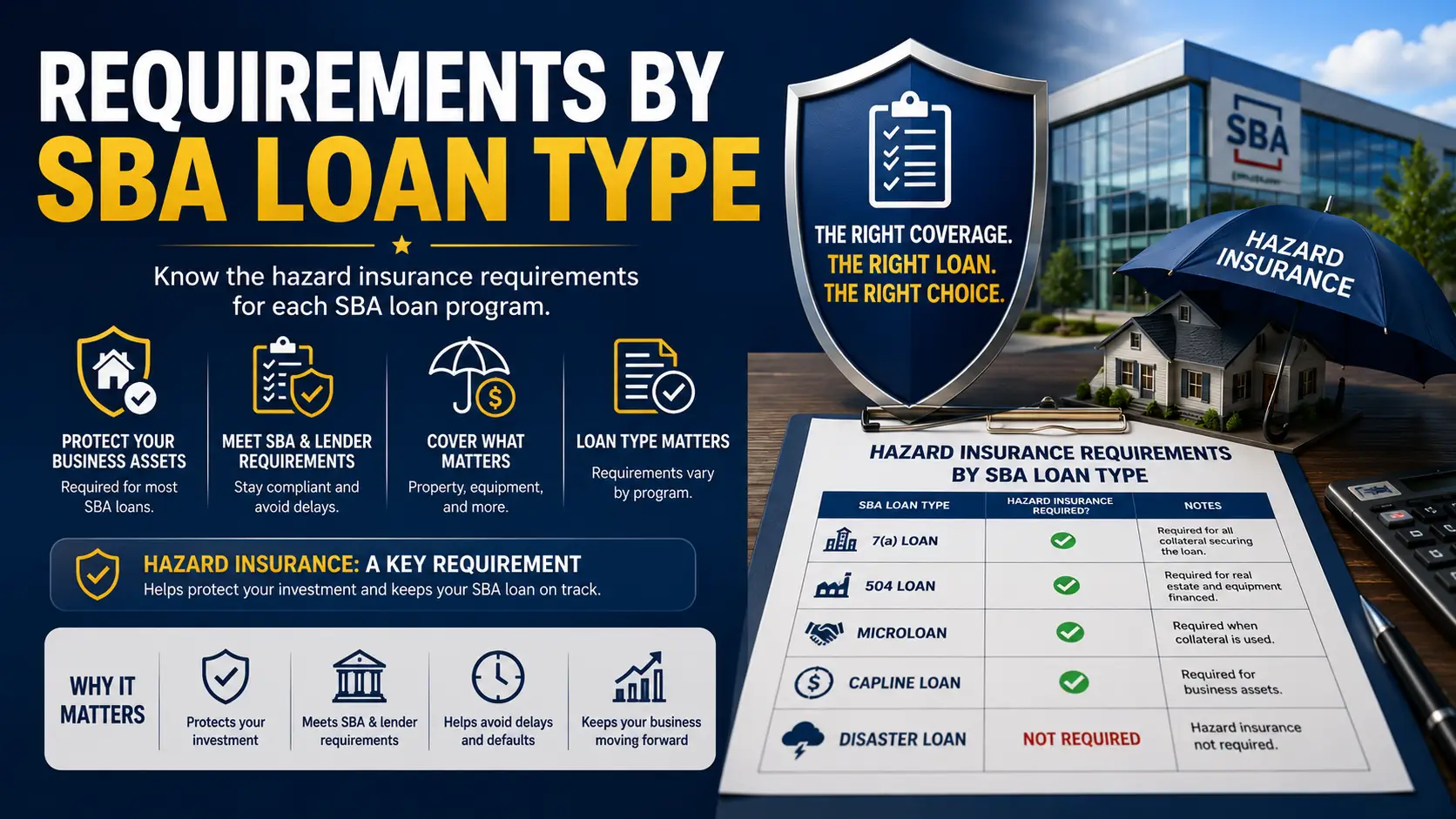
For any 7(a) loan greater than $50,000, the SBA requires hazard insurance on every asset pledged as collateral — no exceptions. One notable carve-out: SBA Express and Export Express loans are exempt from this requirement.
SBA 504 Loans
504 loans finance owner-occupied commercial real estate and major fixed assets, which almost always serve as the loan's own collateral. Any 504 project over $50,000 now requires hazard insurance on the pledged collateral, matching the 7(a) standard.
SBA EIDL Loans
Economic Injury Disaster Loans work a bit differently. An EIDL only requires hazard insurance when the loan is secured by real property — meaning the SBA has placed a lien on land or a building you own. If your EIDL is unsecured, there's no hazard insurance condition in the loan agreement, though carrying coverage is still smart risk management for your own protection.
What Does Hazard Insurance Actually Cover?
Commercial property/hazard policies are generally written to protect physical business assets — buildings, equipment, inventory, fixtures, and furniture — against common perils such as fire and smoke, windstorms, hail, theft, and vandalism. Most policies also offer optional business income coverage, which can replace lost revenue while you rebuild or repair after a covered loss.
The SBA expects coverage written at one of two levels:
- Full replacement cost — the standard requirement, covering what it actually costs to rebuild or replace the asset today
- Maximum insurable value — used only when full replacement cost coverage isn't available for that type of property
Standard hazard/commercial property policies typically exclude flood and earthquake damage. If your region carries elevated risk for either, expect to need a separate rider or standalone policy — which your lender will also require proof of before closing.
How Much Does SBA Hazard Insurance Cost?
On average, small business owners spend between $45 and $85 per month on hazard insurance, though your actual premium depends heavily on your property's value, location, construction type, and industry. One large insurance marketplace, Insureon, puts its customers' average commercial property premium at $67 per month, or roughly $800 per year.
Factors that move your premium up or down include:
- Replacement value of the building, equipment, and inventory you're insuring
- Geographic and weather risk (coastal, wildfire, or tornado-prone areas cost more)
- Building age, construction materials, and fire-protection systems
- Your industry and the flammability/risk profile of what you store or produce
- Deductible level you choose
One upside for borrowers: some lenders roll the first year's hazard insurance premium into total loan closing costs, so it may not always show up as a separate out-of-pocket expense at closing — confirm this directly with your loan officer.
The Mortgagee Clause and Lender's Loss Payable Clause
Every SBA-compliant hazard policy needs specific language protecting the lender's financial interest in your collateral, not just yours. Real estate hazard insurance must include a mortgagee clause, while personal property hazard insurance must include a lender's loss payable clause, each naming the lender and providing that no action or failure to act by you as the property owner can invalidate the lender's interest in a claim. The policy also has to guarantee at least ten days' written notice to the lender before it can be cancelled.
This is the exact wording insurance brokers get wrong most often — a generic "additional insured" listing is not the same as a mortgagee clause or loss payable clause, and lenders will reject a certificate that's missing it.
Flood Insurance: A Separate (and Often Overlooked) Requirement
Flood insurance is governed by different federal law than hazard insurance, and plenty of borrowers assume one policy covers both. It doesn't. Under the Flood Disaster Protection Act of 1973, a borrower must obtain flood insurance if any building, machinery, or equipment financed with SBA proceeds — including mobile homes on a foundation, plus any related inventory, fixtures, or furnishings — sits in a FEMA-designated special flood hazard area.
How much coverage you need is its own calculation. The policy must equal the outstanding principal balance of the loan or the maximum coverage limit available under the National Flood Insurance Program, whichever is lower. The NFIP caps commercial coverage at $500,000 per building and $500,000 for contents, so larger commercial deals in flood zones often need a private or excess flood policy layered on top to fully cover the collateral.
Private flood insurance is acceptable in place of an NFIP policy as long as it offers coverage at least as broad as the standard NFIP policy and includes an endorsement requiring 45 days' notice before cancellation or non-renewal — notably longer than the 10-day notice period required for hazard insurance.
How to Get Hazard Insurance for Your SBA Loan
- Get the exact clause wording from your lender. Ask your loan officer for the precise mortgagee clause or lender's loss payable clause language, plus the flood-zone determination for every property you're pledging as collateral.
- Inventory every asset you're pledging. List each building, piece of equipment, vehicle, and major asset, and estimate its true replacement cost — underestimating this is the fastest way to end up underinsured.
- Shop multiple carriers or use a broker. Commercial property insurance pricing varies significantly by carrier; get at least two or three quotes.
- Confirm flood zone status before you commit to coverage. If any pledged property sits in a special flood hazard area, you'll need a separate NFIP or qualifying private flood policy in addition to hazard insurance.
- Submit your certificate of insurance (COI) to your lender before closing. Your lender needs to verify the clause language and coverage amount ahead of your closing date — don't wait until the week of closing to start this process.
- Maintain coverage for the full life of the loan. Letting your policy lapse can put your loan in default and put the lender's guaranty at risk.
Common Mistakes That Delay SBA Loan Closings
- Assuming the old $500,000 threshold still applies. If your collateral is worth more than $50,000, you need coverage — full stop, under the current rule.
- Insuring for actual cash value instead of replacement cost. ACV policies pay out depreciated value, which usually falls short of what the SBA requires.
- Missing the exact mortgagee or loss payable clause wording. A generic additional-insured endorsement won't satisfy the lender's requirement.
- Forgetting flood insurance in a FEMA-designated zone. This is a separate policy from hazard insurance and is federally mandated, not optional.
- Letting a policy lapse mid-loan. Missing renewal can trigger lender-placed insurance, which typically costs more and offers less protection than a policy you shop for yourself.
Frequently Asked Questions (FAQs)
Is hazard insurance the same as homeowners insurance?
Not for a business loan. Hazard insurance in the SBA context refers to commercial property coverage on business assets. The term "hazard insurance" also appears inside residential homeowners policies as the portion covering the structure itself, which causes some of the naming confusion — but for a business loan, you're shopping for commercial property insurance.
Can I use my existing business insurance policy?
Possibly — if your current commercial property policy already covers the pledged collateral at full replacement cost and can be amended to include the correct mortgagee or loss payable clause, your insurer may be able to endorse the existing policy rather than issue a new one.
What happens if my hazard insurance lapses during the loan term?
Your lender is required to monitor coverage and will typically notify you first. If you don't reinstate it, the lender can force-place a policy on your behalf and bill you for it — usually at a higher cost and with narrower coverage than a policy you select yourself.
Do SBA Express loans need hazard insurance?
No. SBA Express and Export Express loans are specifically exempted from the hazard insurance requirement that applies to standard 7(a) loans.
Does hazard insurance cost get added to my loan amount?
Sometimes. Ask your lender directly — some SBA lenders include the first year's premium in total closing costs, while others expect it paid separately before funding.
Bottom Line
The rule that matters most in 2026: hazard insurance is now required on any SBA 7(a) or 504 loan collateral over $50,000, not $500,000 — a tenfold drop from where the threshold sat as recently as last year. Confirm your exact requirement with your lender early, get the mortgagee or loss payable clause wording right the first time, and check separately whether your collateral sits in a flood zone. Handling insurance in the first week of your loan process, rather than the week of closing, is the single biggest thing you can do to avoid a delayed funding date.
This article is for informational purposes only and does not constitute insurance, legal, or financial advice. SBA loan requirements are subject to change; confirm current terms with your SBA lender or a licensed insurance agent before making coverage decisions.