Subprime Auto Loans: Complete Guide to Getting Approved With Bad Credit
If your credit score sits below 600, you've probably noticed that shopping for a car loan feels different. The rate quotes are higher, the "call for pricing" answers are vaguer, and it's not always clear which lenders are actually willing to work with you versus which ones are just hoping to flip you into a bad deal.
That gap matters more this year than it has in a while. Subprime borrowers made up roughly 15.75% of all vehicle financing in the first quarter of 2026, up from about 14.4% a year earlier, and the used-vehicle subprime share climbed even further to around 20.6%. At the same time, the agency that's supposed to police auto lenders — the Consumer Financial Protection Bureau — has spent most of the past year fighting to stay funded, and one of the industry's fastest-growing subprime lenders collapsed into bankruptcy under fraud charges. More on both of those below, because they change how careful you need to be right now.
This guide covers what "subprime" actually means, what these loans cost at each credit tier in 2026, where to actually apply, the scams to watch for, and the specific steps that improve your odds of approval without setting yourself up to fail.
What "Subprime" Actually Means
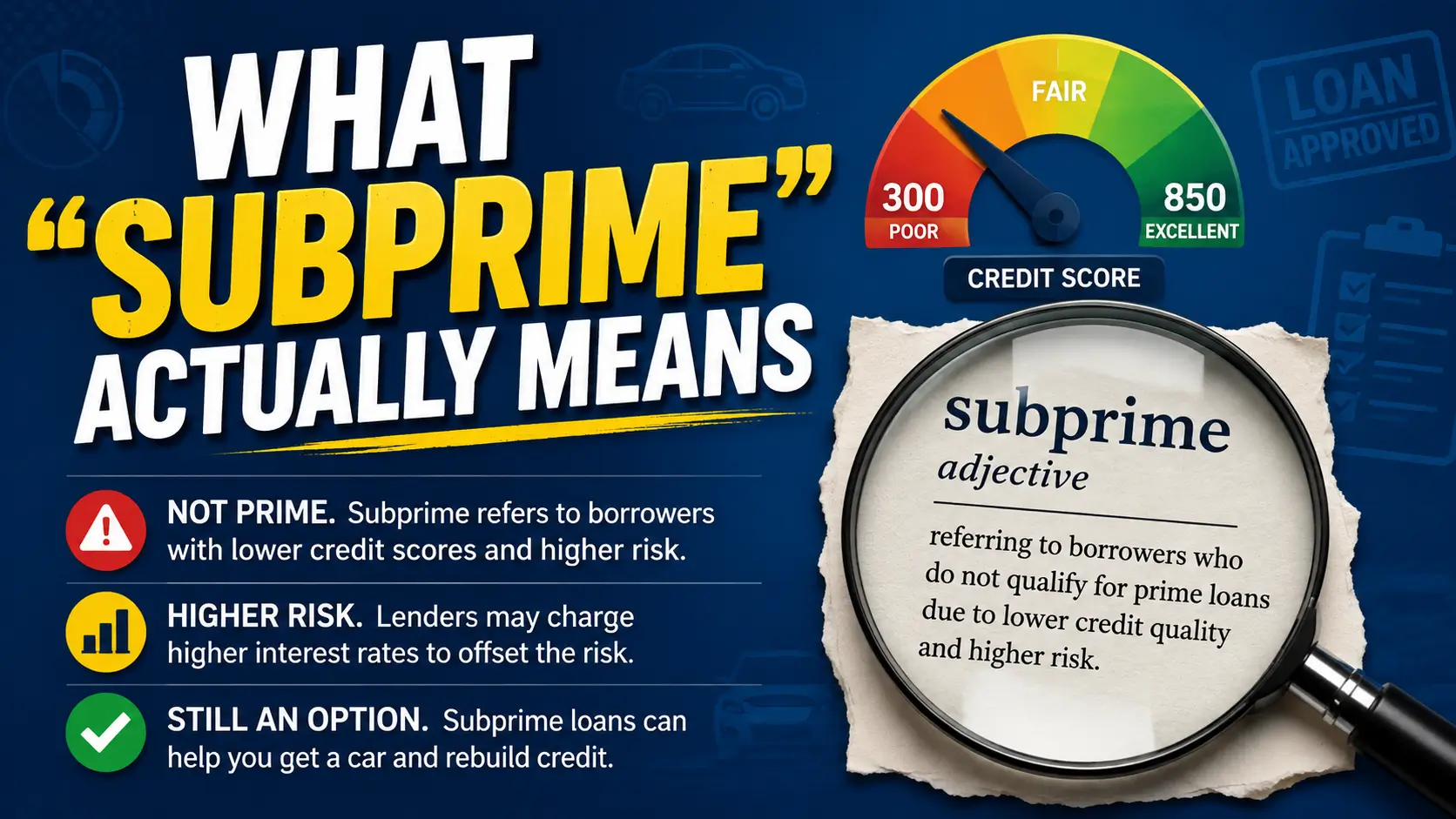
Lenders sort auto loan applicants into credit tiers, and the tier you land in — more than almost anything else — determines your interest rate. Auto lenders typically use FICO Auto Score or VantageScore models rather than your general credit score, but the tiers track closely with the ranges most people are already familiar with:
| Tier | Credit score range | What it means for you |
|---|---|---|
| Super prime | 781–850 | Best available rates, widest lender choice |
| Prime | 661–780 | Competitive rates, most lenders will approve you |
| Near prime | 601–660 | Noticeably higher rates, still broad lender access |
| Subprime | 501–600 | High rates, fewer lenders, often need a down payment |
| Deep subprime | 300–500 | Highest rates, smallest pool of lenders, income verification is heavier |
"Subprime" and "deep subprime" are the two tiers this guide focuses on, though most of the strategy below applies just as well if you're sitting in near prime and trying to avoid sliding into a worse offer.
One thing worth knowing: subprime financing isn't only for people with a history of missed payments. Lenders in this space also work with buyers who simply have a thin credit file — recent immigrants, young buyers, or anyone who hasn't had much credit activity yet. If that's you, proof of steady income (pay stubs, bank statements, tax records) often matters as much as the credit score itself.
What Subprime Auto Loans Actually Cost in 2026
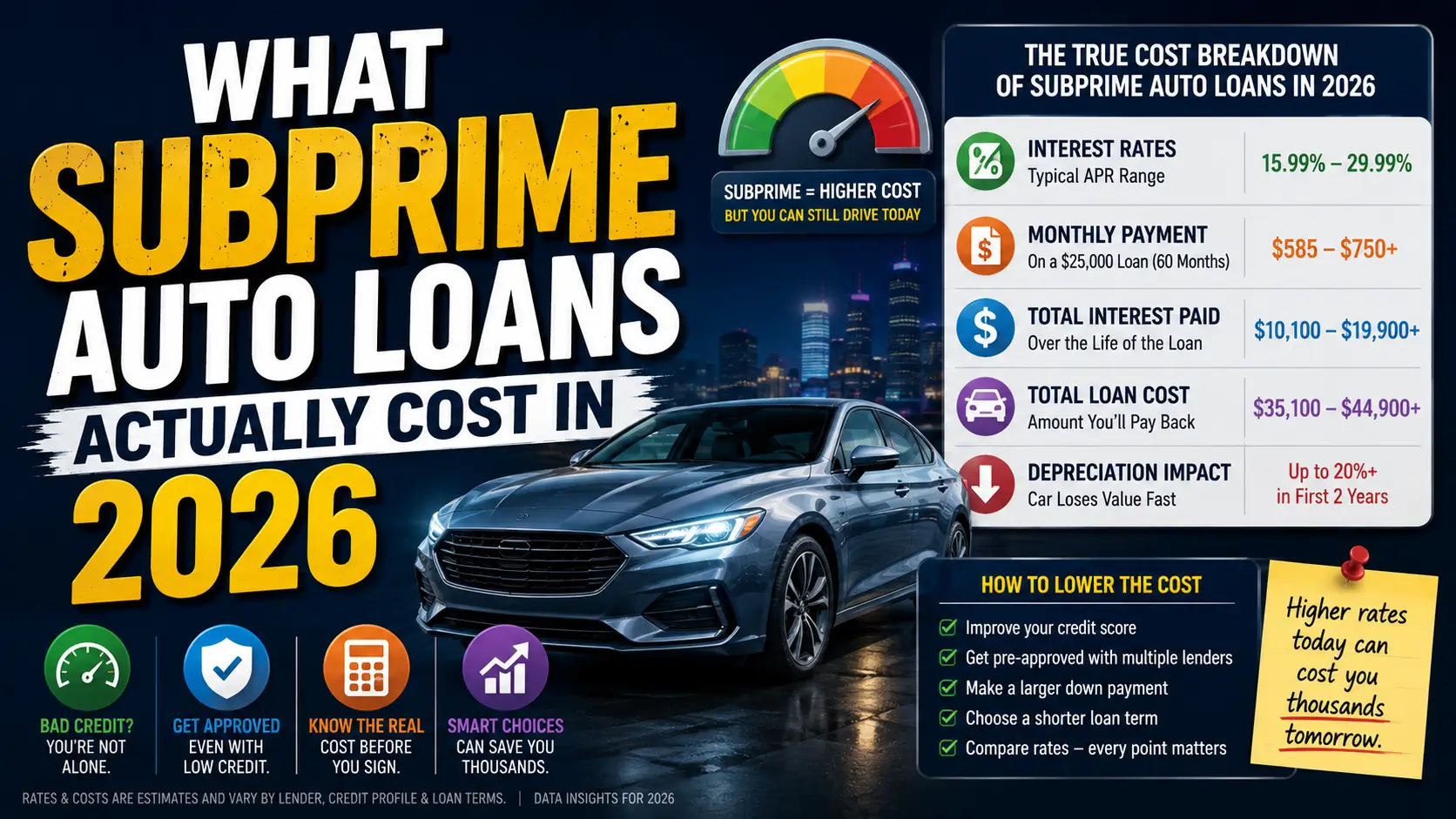
Here's where the tiers translate into real dollars. According to Experian's Q1 2026 State of the Automotive Finance Market data, average APRs by tier look like this:
| Credit tier | Avg. APR (new car) | Avg. APR (used car) |
|---|---|---|
| Super prime (781–850) | 4.55% | 6.30% |
| Prime (661–780) | 6.23% | ~8–9%* |
| Near prime (601–660) | 9.67% | 13.74% |
| Subprime (501–600) | 13.44% | ~19% |
| Deep subprime (300–500) | 16.01% | 21.58%–21.77% |
*Prime-tier used-car averages vary more by source; expect roughly 2–3 points above the new-car prime rate.
Those percentage gaps look abstract until you run them against a real loan. On a $30,000 loan over 60 months:
- At 6.23% (prime): about $583/month, roughly $4,992 in total interest
- At 13.44% (subprime): about $689/month, roughly $11,362 in total interest
- At 16.01% (deep subprime): payments climb further, and the superprime-to-deep-subprime gap alone adds an estimated $13,000+ in extra interest over the loan's life
That's the real cost of the subprime tier: not just a higher monthly payment, but often $6,000–$13,000+ more paid over the life of the loan for the same car. It's also why a modest credit score improvement before you apply — even 20–30 points — can be worth more than hours of haggling on the vehicle price.
Where to Actually Get a Subprime Auto Loan
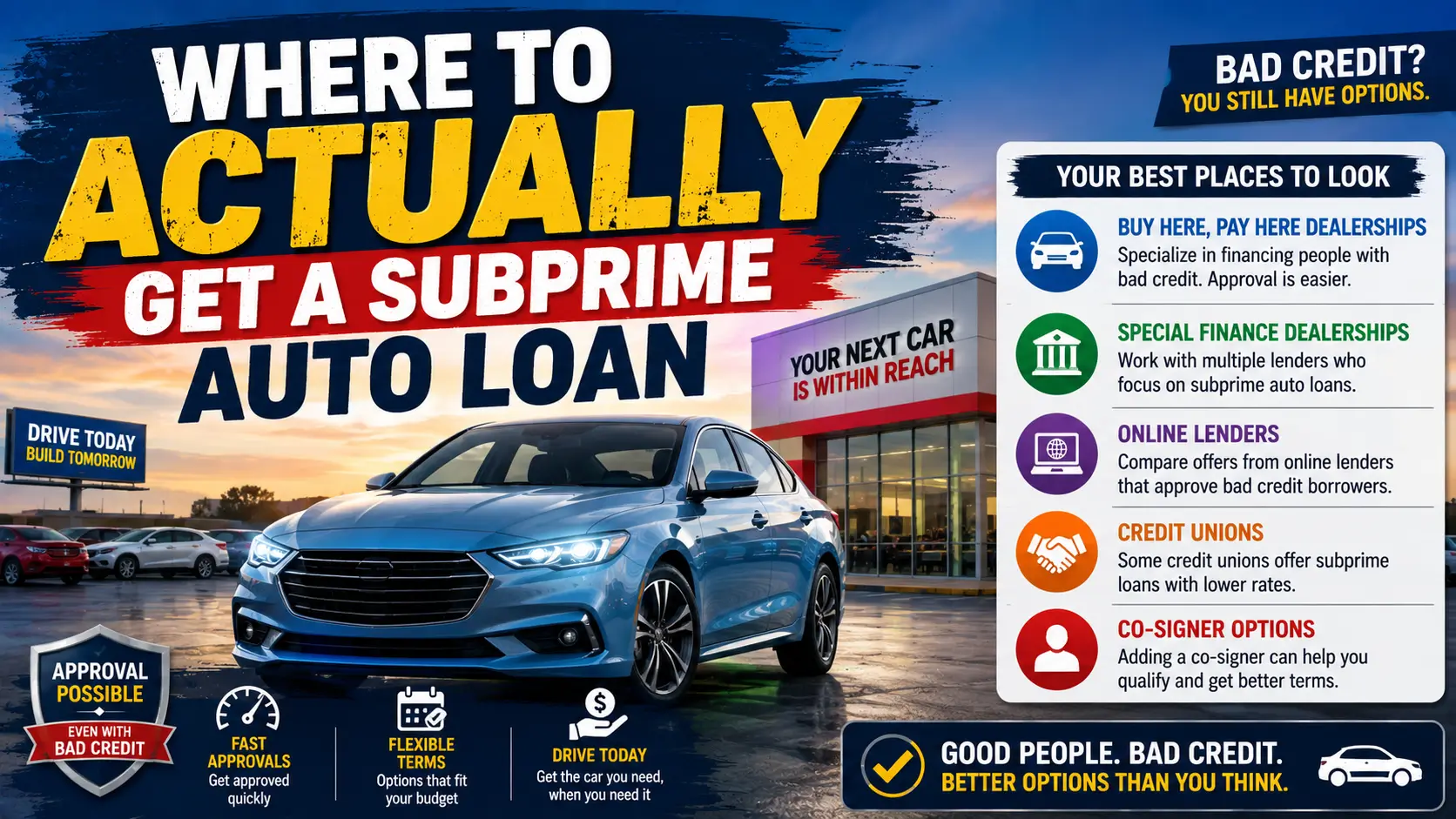
Not all subprime lenders are created equal. In rough order of buyer-friendliness:
Credit unions. Often your best option if you already have an account. Credit unions tend to offer lower rates than banks or online lenders for the same credit tier, and they're more willing to consider your full relationship with them — not just your score. The tradeoff is you usually need to be a member first, and approval can take longer than a dealership's in-house financing.
Banks. Worth checking if you have an existing relationship (a checking account in good standing helps), but banks generally have higher minimum score requirements than credit unions and can be slower to approve subprime applications.
Online lenders and lending networks. Services that match you with multiple potential lenders based on one application. Convenient for comparing offers without multiple hard inquiries (most use a soft pull for the initial quote), but read the fine print — some of these networks route subprime applicants straight to buy-here-pay-here dealers.
Dealer-arranged financing. The dealership shops your application to its network of lenders. Convenient and often fast, but the dealer can mark up the interest rate it receives from the lender and keep the difference — a legal practice, but one more reason to arrive with a pre-approval in hand so you have something to compare against.
Buy-here-pay-here (BHPH) dealers. The dealer is the lender — you make payments directly to the lot instead of a bank. This is the option with the fewest credit or income requirements, and it's often the last door open to deep-subprime buyers. It's also the option with the most documented history of predatory pricing. Treat BHPH as a last resort, not a first stop.
Practical move: apply for pre-approval with a credit union or online lender before you set foot on a dealership lot. Walking in with a real rate in hand turns the negotiation from "can I get approved" into "can you beat this," which is a much stronger position.
Step-by-Step: Improving Your Approval Odds
- Pull your credit reports and actually read them. Errors on subprime files are common enough that a dispute alone can sometimes bump you into a better tier. You're entitled to free reports from all three bureaus.
- Get pre-approved before you shop. This tells you your real rate range and caps how much a dealer can mark things up. It also protects you from a dealer telling you "the bank came back higher" with nothing to check that claim against.
- Save for a down payment. Industry guidance generally points to 10–20% of the purchase price. A larger down payment lowers your loan-to-value ratio, which lenders weigh heavily for subprime applicants, and it directly cuts the interest you'll pay.
- Consider a qualified co-signer. Someone with stronger credit attached to the loan can meaningfully improve your rate — but make sure they understand they're on the hook if you miss payments. This is a real financial risk for them, not a formality.
- Choose the loan term deliberately, not just for the lowest payment. Stretching to 72 or 84 months lowers the monthly bill but increases total interest and raises the odds you'll be "underwater" (owing more than the car is worth) for years.
- Buy less car than you're approved for. Subprime approval amounts can be generous relative to what's actually affordable. A smaller loan is a safer loan, especially at double-digit APRs.
- Have your income documentation ready. Recent pay stubs, bank statements, and — if you're not a W-2 employee — tax records. The more clearly you can show consistent income, the less a lender has to price in uncertainty.
- Decline the add-ons, or at least separate them from the price talk. Extended warranties, GAP insurance, and service contracts are sometimes worth having, but they're routinely marked up at the point of sale. Negotiate the vehicle price and loan rate first; consider add-ons separately, and know you can usually buy GAP coverage or an extended warranty elsewhere for less.
Red Flags: Protecting Yourself From Predatory Tactics
Subprime buyers are disproportionately targeted by a handful of well-documented dealer tactics. Knowing the names and mechanics of these is the single best protection you have.
Yo-yo financing (spot delivery scam). A dealer lets you drive the car home the same day, before your financing is actually finalized by a lender — a legal practice called "spot delivery." Days or weeks later, they call and say your financing "fell through" and pressure you to sign a new contract at a worse rate or with more money down. If you signed only one retail installment contract and financing was genuinely never finalized, you generally have the right to return the vehicle and get your deposit and trade-in back rather than accept the new terms — but the details depend on your state's law, so document everything and don't feel rushed into re-signing on the spot.
Interest rate markup without comparison. Dealer-arranged financing is legal, but without a pre-approval to compare against, you have no way to know whether the rate you're offered reflects your actual risk tier or an added markup.
Hidden fees. Processing fees, documentation fees, and early-repayment penalties should all be disclosed upfront under the Truth in Lending Act. If a lender is vague about the total finance charge or total cost of the loan, that's a reason to slow down.
"No credit check" offers. Legitimate subprime lenders still verify income and often still check credit, even if the bar is lower. An offer with literally no verification of any kind is a red flag, not a convenience.
High-pressure, same-day-only pricing. You are never obligated to sign on the spot. A legitimate offer will still be there — or close to it — after you've had a night to think it over or a chance to call your credit union.
Why 2026 Is a Riskier Year to Get This Wrong
Two developments this year are worth knowing about specifically because they affect how much protection you can count on if something goes wrong.
CFPB oversight has been significantly reduced. Since early 2025, the CFPB has been in an extended funding fight tied to actions by the Trump administration, which sought to stop the agency's Federal Reserve funding transfers entirely. Federal courts have repeatedly ordered the agency to continue receiving funding, but a January 2026 Government Accountability Office report documented substantial cuts to CFPB staff, contracts, supervision, and enforcement activity through 2025, and the litigation over the agency's funding and structure is still unresolved as of this writing. In practical terms: the federal backstop that has historically pursued cases against predatory BHPH dealers is currently operating with less capacity than it has in years. That doesn't mean state consumer-protection laws or private legal remedies go away — but it does mean self-protection matters more than it used to.
A major subprime lender's collapse is a live reminder of how this can go wrong. In September 2025, Tricolor Holdings — a large buy-here-pay-here lender and used car retailer that had built a loan portfolio serving buyers with thin or no credit files — filed for Chapter 7 bankruptcy and shut down roughly 60 dealerships, leaving around 100,000 loan accounts in limbo. Federal prosecutors later charged the company's founder and COO with running a systematic fraud scheme involving hundreds of millions of dollars in improperly pledged collateral. Borrowers whose loans were mid-transition to a new servicer described confusion over where and how to make payments during the changeover. The point isn't that every BHPH lender is fraudulent — most aren't — but it's a concrete example of why verifying who actually holds your loan, keeping your own payment records, and avoiding lenders with no public track record is worth the extra ten minutes.
Note: the CFPB funding litigation is ongoing and details may have shifted by the time you're reading this — worth a quick check on current status before relying on it.
Rebuilding Credit With (or Instead of) a Subprime Loan
If you can delay the purchase even a few months, targeted credit-building moves can shift you into a meaningfully cheaper tier:
- Pay down revolving balances. Credit utilization is one of the fastest-moving factors in most scoring models.
- Fix reporting errors. Subprime files disproportionately contain inaccuracies; a successful dispute can move your score without you doing anything else.
- Add a secured credit card or credit-builder loan if your file is thin rather than damaged, and keep both current.
- Avoid new hard inquiries in the weeks before you apply for the auto loan — each one has a small but real short-term impact.
If a car is a genuine near-term necessity and waiting isn't realistic, that's exactly when the steps above — pre-approval, a real down payment, a cautious loan term, and a healthy skepticism toward same-day pressure — matter most.
Frequently Asked Questions (FAQs)
What credit score counts as subprime for a car loan?
Most lenders treat scores from 501–600 as subprime and below 500 as deep subprime, though the exact cutoff varies by lender and shifts somewhat with the broader economy.
Can I get an auto loan with a 500 credit score?
Yes, though options narrow to deep-subprime lenders and BHPH dealers, and you should expect a higher down payment requirement and heavier income documentation.
Are buy-here-pay-here loans a bad idea?
Not automatically, but they carry more documented risk of high rates, aggressive repossession practices, and limited recourse than bank, credit union, or online-lender financing. Treat BHPH as a last resort after other options are exhausted.
Will applying to multiple lenders hurt my credit score?
Auto loan inquiries made within a short window (typically 14–45 days, depending on the scoring model) are generally counted as a single inquiry for scoring purposes, so rate-shopping across several lenders in a short period is low-risk.
Does a subprime auto loan help rebuild my credit?
Making on-time payments on any installment loan, including a subprime auto loan, is reported to the credit bureaus and can help your score over time — but a missed payment or repossession does the opposite, and does so quickly.
What's the difference between a cosigner and a joint applicant?
A cosigner's credit and income support your application but they typically have no ownership claim to the vehicle. A joint applicant (sometimes called a co-borrower) is equally responsible for the loan and usually has ownership rights too. Not all lenders offer both structures — ask before assuming.
This article is for general information and isn't personalized financial or legal advice. Loan terms, rates, and lender availability vary by state and change over time — confirm current numbers with lenders directly before making a decision.