Truck Accident Lawsuit Loans: Everything You Need to Know Before Applying
After a serious truck accident, medical bills and missed paychecks can pile up long before an insurance company ever writes a check. Commercial trucking claims typically take longer to resolve than a standard car accident case, and that gap is exactly what pushes many injured plaintiffs to look into a truck accident lawsuit loan — cash advanced against a future settlement. It's a legal option in nearly every state, but it's also one of the more expensive ways to get money, and the rules around it are changing fast in 2026. This guide covers how truck accident lawsuit loans actually work, why trucking cases play out differently than ordinary car accident claims, what these advances really cost, where state regulation currently stands, and what to compare before signing anything.
This article is for general information only and isn't legal or financial advice. Talk to your attorney before signing any funding agreement.
What Is a Truck Accident Lawsuit Loan?
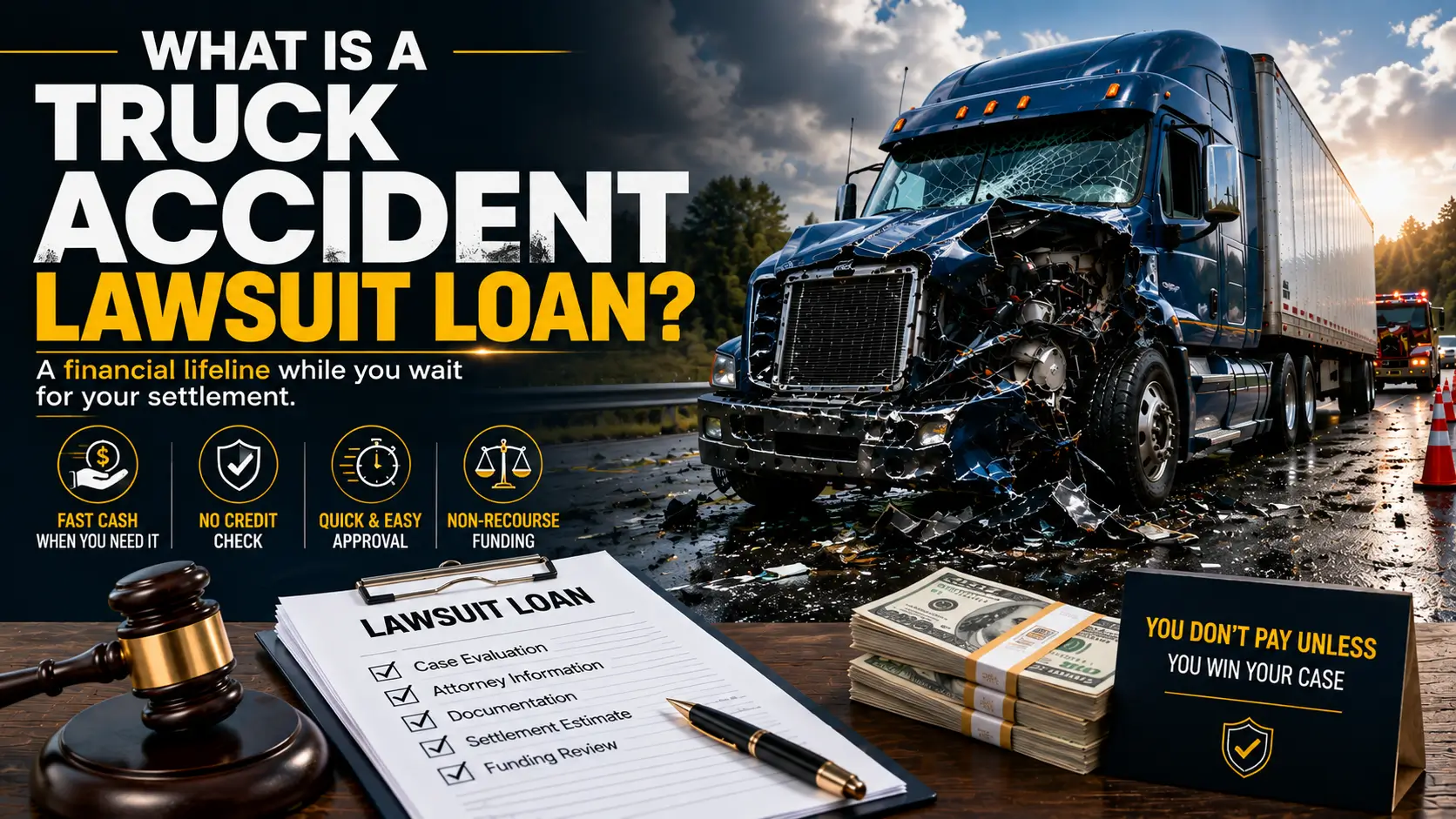
"Truck accident lawsuit loan" is marketing language, and it's a little misleading. The products sold under that name — also called pre-settlement funding, a lawsuit cash advance, or legal funding — usually aren't loans in the legal sense at all. In most states, they're structured as a non-recourse purchase: the funding company buys the right to a portion of your future settlement. If you lose your case, you typically owe nothing back. If you win, the company is repaid out of the proceeds, usually before the money reaches your pocket.
That non-recourse structure is also the reason these products mostly escape the interest-rate caps (usury laws) that apply to conventional loans. Because legally there's no loan and no guaranteed repayment, most states haven't treated the "fee" a funding company charges as regulated interest — though, as covered below, that's starting to change.
A few things this product is not:
- Not a bank loan. No bank or credit union is involved, and it won't show up on your credit report either way.
- Not based on your credit or income. Approval is based on the strength of your case — liability, available insurance, and expected settlement value — not your credit score or employment.
- Not the same as a "legal loan" some companies also offer to cover attorney retainers or hourly fees for cases like divorce or immigration. Lawsuit loans are specifically an advance against an existing injury claim's expected proceeds, and they require an attorney already representing you on contingency.
- Not the same as commercial litigation funding, where investors fund a law firm's caseload or a business's lawsuit. This article is about consumer/plaintiff funding tied to a personal injury claim.
Why Truck Accident Cases Are Different From Car Accident Cases
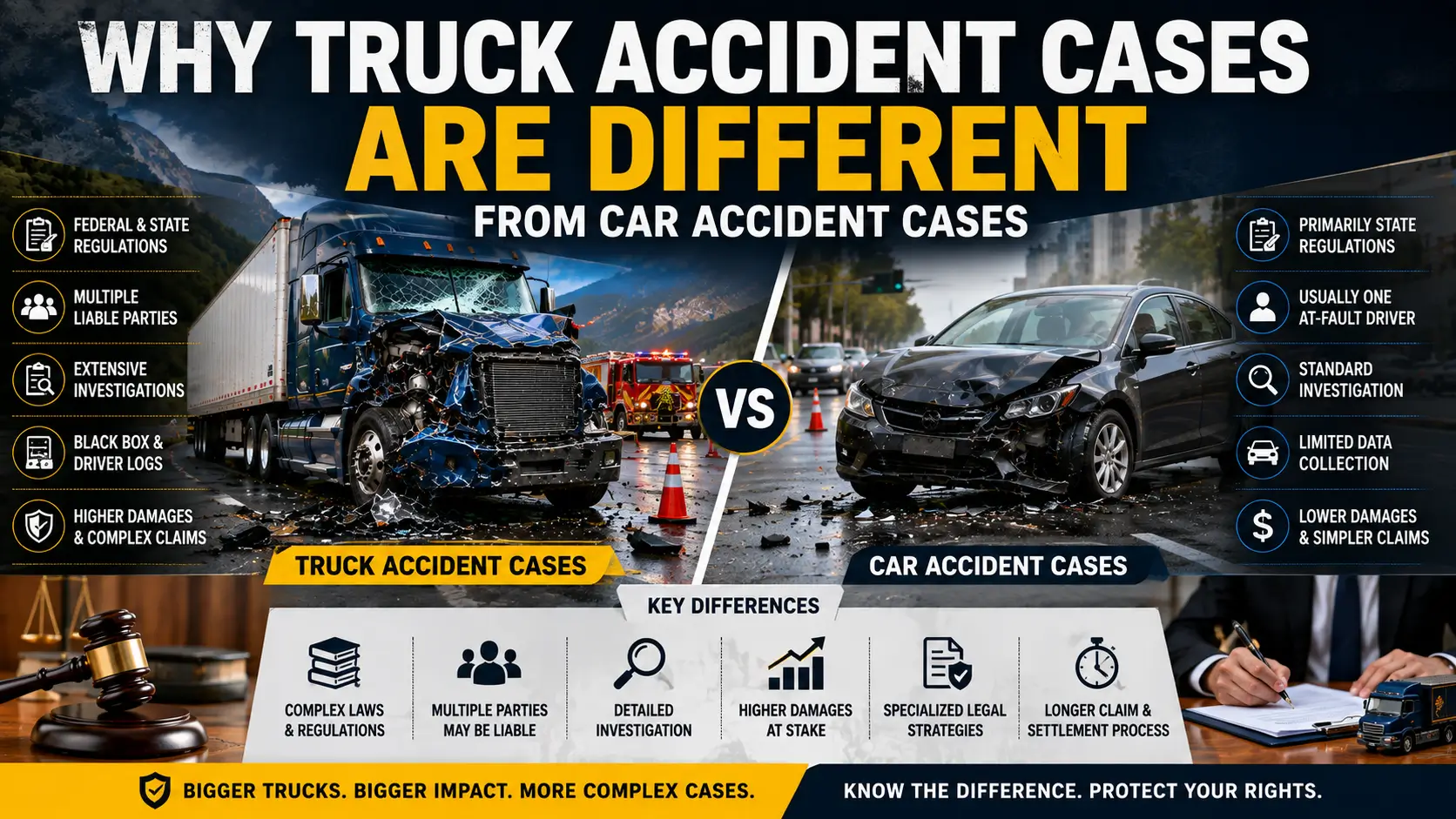
Most articles about lawsuit loans are written around a generic car accident and never mention what actually changes when the at-fault vehicle is a commercial truck. That's a gap worth closing, because it directly affects both the size of a typical offer and how much a truck accident lawsuit loan can end up costing.
More money is usually on the table — and more parties are usually liable. Interstate trucking companies hauling general freight are required to carry a minimum of $750,000 in liability insurance under federal rules set by the Federal Motor Carrier Safety Administration (FMCSA) — a floor that hasn't changed since 1985. Carriers hauling hazardous materials must typically carry $1 million to $5 million, and many freight brokers and shippers require $1 million in coverage even when the legal minimum is lower. Compare that to a typical car accident, where the at-fault driver's insurance is often limited to a state minimum in the tens of thousands of dollars. Larger policy limits generally mean larger potential settlements — and larger settlements are part of what makes funding companies willing to advance bigger amounts against a trucking claim.
It's also common for more than one party to share liability in a truck accident: the driver, the motor carrier, a cargo loading company, a maintenance contractor, a freight broker, or even the vehicle or parts manufacturer. Sorting out who's responsible, and to what degree, adds time to a case.
Federal rules add discovery complexity. Truck accident litigation typically involves pulling driver hours-of-service logs, electronic logging device (ELD) data, driver qualification files, and maintenance records — all governed by FMCSA regulations. Preserving and analyzing this evidence takes longer than a typical two-car crash investigation, and insurers defending a trucking company tend to litigate harder given what's at stake.
The upshot: longer timelines. Across personal injury and trucking-focused law firms, truck accident cases commonly settle somewhere between 6 months and 3 years, with cases involving serious injuries, disputed liability, or multiple defendants trending toward the longer end. That timeline matters enormously for a lawsuit loan, because in a lot of funding contracts, the fee compounds monthly — the longer the case runs, the more the advance grows before it's repaid.
One more thing worth watching: FMCSA has signaled it may raise the $750,000 minimum insurance requirement, with a formal proposal (not yet a final rule) reportedly under development that could push the floor to $2 million or higher for general freight carriers. If that change goes through, it could shift both settlement values and, potentially, funding offers on future truck accident cases. (Status of this rulemaking should be reconfirmed before publish — it was still proposed, not final, as of this draft.)
How the Application Process Works
Because approval hinges on the case rather than the applicant, the process looks different from a bank loan application:
- You need an attorney already handling your case on contingency. Funding companies work through your lawyer, not around them — most require your attorney's cooperation to release case information and to handle repayment later.
- You (or your attorney) submit case details. This typically includes the attorney's contact information, a summary of the accident and injuries, the insurance coverage involved, and an expected settlement range.
- The funding company underwrites the case, not you. No credit check and no proof of income. Underwriters look at how clear liability is, how much insurance is available, the severity of documented injuries, and how far along the case is.
- If approved, you sign a funding agreement. This is the point to slow down and read closely — it should spell out the amount advanced, the fee structure, whether the fee compounds, and the total payoff at various points in time, not just a monthly rate.
- Funds are typically released within a day or two of signing, sometimes as fast as 24 hours, direct to your bank account.
- Repayment happens automatically if you win or settle. Your attorney pays the funding company out of the settlement proceeds, generally after attorney's fees and any medical liens are accounted for. If the case is lost, most agreements require no repayment at all.
Funding companies commonly cap how much they'll advance — often a modest percentage of the expected net settlement, so there's still meaningful money left for the plaintiff after attorneys' fees, liens, and the funder's payoff are all subtracted. The exact cap varies by company and by case.
What a Truck Accident Lawsuit Loan Really Costs
This is the part that matters most, and the part sales pages tend to gloss over. Because the product isn't legally a "loan," companies charge a "fee" or "rate" instead of interest — but the effect on your wallet is the same, and in a lot of cases it's steep.
Typical pricing. Across funding companies and legal-information sources, monthly rates in the roughly 2% to 5% range are common, with the rate set case-by-case based on how strong and how far along the claim looks. Multiple industry sources — including some funding companies' own published rate disclosures — put the average effective annual cost of pre-settlement funding at around 60%. Critics, including tort-reform advocacy groups, point to specific contracts running as high as roughly 124% APR in states with no rate limits, and at least one academic analysis of court-level data has reported effective APRs exceeding 150% in certain compounding arrangements. These figures vary widely by source and by methodology, and given how fast this market and its regulation are moving, the specific percentages should be reconfirmed against current sourcing before this goes live.
The single biggest factor: compounding vs. simple. Some contracts charge a flat, non-compounding rate. Others compound monthly, meaning each month's fee is calculated on the growing balance, not just the original amount. Over a short case, the difference is modest. Over a long one — and truck accident cases often are long ones — it compounds into a very different number.
Here's a hypothetical example, not a quote from any specific company, using a $25,000 advance at a 3%-per-month rate (within the commonly cited industry range) to show how much that gap can matter:
| Time to settle | Compounding fee | Compounding payoff | Simple (flat) fee | Simple payoff |
|---|---|---|---|---|
| 6 months | $4,851 | $29,851 | $4,500 | $29,500 |
| 12 months | $10,644 | $35,644 | $9,000 | $34,000 |
| 18 months | $17,561 | $42,561 | $13,500 | $38,500 |
| 24 months | $25,820 | $50,820 | $18,000 | $43,000 |
| 36 months | $47,457 | $72,457 | $27,000 | $52,000 |
Illustrative only, at a 3%/month rate. Your actual rate, structure, and payoff will depend on your case and provider.
Notice that at the 24-month mark — well within the normal range for a truck accident case — a compounding structure roughly doubles the original advance in fees, while a simple/flat structure charges meaningfully less for the same delay. Some providers advertise "non-compounding" or "simple interest" rates specifically because of this gap. Before signing anything, ask for the total dollar payoff at 12, 24, and 36 months, not just the monthly percentage — and get it in writing.
Is a Truck Accident Lawsuit Loan Regulated? Where State Rules Stand in 2026
There's no federal law governing consumer legal funding, so oversight is a state-by-state patchwork — and it's shifting quickly:
- Missouri has regulated consumer legal funding for years, treating it as the sale of a consumer asset rather than a loan while requiring clear disclosures.
- Kansas's Transparency in Consumer Legal Funding Act takes effect July 1, 2026, and includes a 10-day right to cancel without penalty, a codified non-recourse guarantee, a requirement that contracts be written in plain language, and mandatory disclosure of the funded amount, fees, and maximum repayment schedule.
- New York's Consumer Litigation Funding Act, signed in early 2026, brings most of its consumer-facing provisions into effect June 17, 2026 — including plain-language disclosure of all charges and cumulative repayment amounts and a 10-business-day right to cancel — with company registration and reporting requirements following in 2027.
- Several other states passed broader third-party litigation funding disclosure laws in 2025. Many of these focus on disclosing the existence of funding to courts or opposing parties rather than setting the same consumer-protection terms as a dedicated Consumer Legal Funding Act, so it's worth checking which category applies in your state.
- Plenty of states still have no funding-specific law on the books at all, which means protections can vary sharply depending on where your case is filed.
Two industry trade groups — the Alliance for Responsible Consumer Legal Funding (ARC) and the American Legal Finance Association (ALFA) — promote voluntary best practices among member companies, such as written non-recourse disclosures and a target Better Business Bureau rating. That's worth knowing about, but it's self-regulation, not a substitute for a state law, and not every company in the market belongs to either group.
Because 2025–2026 has seen unusually heavy legislative activity in this space, the state-by-state specifics above should be reconfirmed against current statutes for the reader's state before this post is published.
It's also worth knowing this product has drawn real criticism from more than one direction. Consumer advocacy groups have raised concerns about high effective costs landing on financially vulnerable accident victims. Separately, tort-reform organizations and trucking-industry groups — including the American Trucking Associations — have publicly criticized litigation funding as well, though largely because it can strengthen an injured plaintiff's ability to hold out for a fuller settlement rather than accept an early, lower offer from an insurer. Those are two different concerns for two different reasons, but both are worth knowing about if you're deciding whether to use one of these products.
Truck Accident Lawsuit Loans vs. Other Ways to Cover Expenses
A lawsuit loan is rarely the cheapest option — it's usually the option of last resort for someone who doesn't qualify for, or doesn't want to take on, recourse debt while a case is pending.
| Option | Credit check? | Typical cost | If you lose your case | Speed |
|---|---|---|---|---|
| Truck accident lawsuit loan | No | High (see above) | Usually nothing owed (non-recourse) | 1–2 days after approval |
| Personal loan (bank/credit union) | Yes | Lower, fixed-rate | You still owe the full balance | Days to a couple weeks |
| Credit card cash advance | Yes (for the card) | High APR + cash advance fee | You still owe the full balance | Immediate |
| Medical lien or provider payment plan | No | Often no added interest | Owed regardless of case outcome, from any recovery or your own funds | Depends on provider |
| Borrowing from family/friends | No | Whatever you agree to (often $0) | Depends on your agreement | Fast |
| Negotiating a faster, smaller settlement | N/A | Opportunity cost (lower payout) | N/A | Weeks |
The core tradeoff: a lawsuit loan is the only option here where you owe nothing if you lose the case — but that non-recourse guarantee is exactly what the high cost is pricing in. Every other row on this table is either cheaper or faster, but shifts real repayment risk back onto you.
Pros and Cons of Truck Accident Lawsuit Loans
Pros
- No repayment if you lose your case (non-recourse)
- No credit check or income verification required
- Funds often arrive within a day or two of approval
- Can relieve pressure to accept a lowball early settlement offer, since you're not forced to settle just to pay bills
- Doesn't add to your traditional debt load or affect your credit
Cons
- Among the more expensive ways to access cash, especially in a case that drags on
- Compounding fee structures can end up costing as much as, or more than, the original advance
- Reduces the amount you ultimately take home from your settlement
- Regulation — and the protections that come with it — varies significantly by state
- Some marketing claims (like funding available "without interest or other fees") can be misleading; a fee-free advance is uncommon in this industry
- Your attorney has to be willing to cooperate, and not every attorney is
How to Compare Funding Companies
If you're going to move forward, a little diligence goes a long way:
- Ask for the total dollar payoff, not just the rate, at several possible settlement dates (e.g., 12, 24, 36 months).
- Ask directly whether the fee compounds or is simple/flat. This single detail can change your final cost by tens of thousands of dollars on a long case, as shown above.
- Check for membership in ARC or ALFA as one (not the only) signal of a company that follows published best-practice standards.
- Confirm there are no undisclosed origination or processing fees deducted from the amount you actually receive.
- Get everything in writing, and have your attorney review the agreement before you sign — most funding companies expect this step anyway.
- Compare more than one offer. Rates and structures vary company to company for the same case.
- Be cautious about taking funding from multiple companies on the same claim ("stacking"). It multiplies fees against the same settlement, and some newer state laws (including Kansas's 2026 law) specifically restrict new funding when a prior funder's interest in the claim hasn't been resolved.
Frequently Asked Questions (FAQs)
Is a truck accident lawsuit loan the same as a bank loan?
No. It's typically structured as a non-recourse purchase of part of your future settlement, not a conventional loan, and it isn't issued by a bank.
Do I need good credit to qualify?
No. Approval is based on the merits and expected value of your case, not your credit score, income, or employment status.
What happens if I lose my truck accident case?
Under a standard non-recourse agreement, you typically owe nothing back. Always confirm this explicitly in writing before signing, since terms can vary by company and by state.
How much can I get against my truck accident settlement?
It depends on the company and the strength of your case. Funders generally cap advances well below the expected net settlement so there's enough left over after attorney's fees, medical liens, and the funder's payoff.
How fast can I actually get the money?
Many companies advertise funding within 24 to 48 hours of a signed agreement, though the underwriting review before approval can take longer depending on how quickly your attorney's office responds to requests for case information.
Will my attorney have to be involved?
Yes. Nearly all legitimate funding companies require you to already be represented by an attorney on your truck accident claim and will coordinate directly with that attorney's office.
Can I get funding from more than one company on the same case?
It's sometimes possible but generally discouraged — stacked advances multiply fees against the same settlement, and some funding agreements and newer state laws restrict it outright when an earlier funder hasn't been paid off or hasn't agreed in writing.
Is the fee on a lawsuit loan tax-deductible?
No. Because it isn't classified as interest on a loan, it generally isn't treated as deductible interest. This isn't tax advice — check with a tax professional about your specific situation.
Bottom Line
A truck accident lawsuit loan can genuinely help someone cover rent, groceries, and medical bills while a complex trucking claim works its way through a process that regularly takes a year or more. But because trucking cases involve larger insurance policies, more potential defendants, and longer timelines than a typical car accident case, the cost math is also bigger — especially if the fee compounds monthly. Before applying, get the total dollar payoff at multiple possible settlement dates in writing, ask specifically whether the rate compounds, check what protections (if any) your state currently provides, and loop in your attorney before you sign anything. For many people, exploring cheaper alternatives first — even a partial one, like negotiating a payment plan with a medical provider — is worth the extra effort before taking on the most expensive option on the list.